Category: Polymarket

  • Polymarket Brings Prediction Markets to Life with Situation Room Pop-Up Bar in DC

    Polymarket Brings Prediction Markets to Life with Situation Room Pop-Up Bar in DC

    Polymarket’s new pop-up bar in Washington, DC, offers a unique venue where real-time prop bets meet in-person interaction, reflecting the growing appetite for prediction markets among executives and policymakers.

    Polymarket, a leading prediction market platform, recently unveiled its “Situation Room” pop-up bar in Washington, DC, marking a novel approach to blending social engagement with real-time prop betting. This initiative reflects Polymarket’s strategy to deepen its foothold in the capital’s business and political circles by providing an experiential space where guests can discuss and wager on current events in a lively atmosphere.

    The Situation Room pop-up bar serves as an in-person extension of Polymarket’s digital platform, allowing users to engage with real-world events through prop bets while networking with peers. This physical presence is particularly notable given the traditional online nature of prediction markets, signaling the company’s ambition to bridge digital innovation with tangible experiences. For executives and founders, this represents an interesting intersection of technology, data-driven decision-making, and social engagement.

    From a business standpoint, Polymarket’s move to create a dedicated venue for its prediction markets in DC could enhance its brand visibility and credibility among policymakers and influencers. It also highlights a broader trend of bringing automation and data analytics, often associated with platforms like Claude and OpenClaw, into more accessible and interactive formats. By creating a space that encourages dialogue and wagers on geopolitical and economic developments, Polymarket is positioning itself as a practical tool for real-time insights and risk assessment.

    The implications for business operators are significant. Prediction markets like Polymarket’s enable participants to aggregate diverse information and sentiment, potentially offering more accurate forecasts than traditional methods. The Situation Room setting can facilitate deeper conversations about market-moving events, enhancing executives’ ability to decode complex signals in an increasingly automated and data-driven environment. This is particularly relevant as automation technologies continue to evolve, with AI assistants like Claude and OpenClaw reshaping how organizations analyze information and make decisions.

    While the pop-up bar is a temporary venture, its presence in the nation’s capital underscores the increasing relevance of prediction markets in strategic planning and competitive intelligence. For leaders, engaging with platforms like Polymarket could provide an edge in anticipating regulatory changes, market shifts, and geopolitical risks. Additionally, the social and interactive nature of the Situation Room can foster stronger networks among professionals who rely on timely and accurate information.

    Polymarket’s Situation Room exemplifies how innovative companies are leveraging both technology and human interaction to create value. As automation and AI continue to transform business landscapes, the integration of real-time prediction markets into executive workflows may become increasingly common. This development invites business leaders to consider how such tools can complement their existing analytics and decision-making processes.

    In sum, the Situation Room pop-up bar reflects Polymarket’s pioneering approach to prediction markets by making them more accessible and engaging for a sophisticated audience. For CEOs and founders, it offers a glimpse into how emerging technologies and formats can enhance strategic foresight and operational agility in a complex world.

    Polymarket’s innovative approach to prediction markets through its “Situation Room” pop-up bar in Washington, DC, signals a strategic effort to merge digital forecasting with face-to-face engagement among key decision-makers.

    By establishing a physical venue in the nation’s capital, Polymarket is tapping into an environment rich with policymakers, lobbyists, and business leaders who rely on timely, data-driven insights. This initiative transcends the conventional online interface of prediction markets by fostering a dynamic space where attendees can not only place prop bets on unfolding geopolitical and economic events but also engage in meaningful conversations that deepen their understanding of market signals. For executives and founders, this creates a unique opportunity to integrate real-time data analytics with networking, potentially informing more nuanced strategic decisions.

    Moreover, the Situation Room reflects a broader trend in automation and predictive technologies, paralleling advancements seen in platforms like Claude and OpenClaw. These tools emphasize the increasing role of AI-driven analysis in interpreting complex global developments. Polymarket’s experiential pop-up underscores the growing demand for accessible, interactive formats that translate automated data into actionable intelligence. For business operators, such environments may enhance their ability to anticipate risks and opportunities by aggregating diverse perspectives and market sentiments in a collaborative setting, complementing traditional forecasting methods and enriching executive decision-making processes.
  • Exclusive: Operator Won Nearly $1 Million on Polymarket Thanks to Surprisingly Accurate Bets on Iran

    Exclusive: Operator Won Nearly $1 Million on Polymarket Thanks to Surprisingly Accurate Bets on Iran

    Polymarket, the decentralized prediction market platform, recently witnessed an extraordinary series of bets that led to nearly $1 million in winnings by a small cluster of operators betting on events related to Iran.

    In early March 2026, Polymarket saw an unprecedented surge in trading volume, with more than $529 million wagered on markets tied to the bombing of Iran. This spike drew attention not only for its scale but also for the precision of certain bettors who capitalized on detailed timing predictions. Analysis revealed that a handful of new accounts were behind nearly $1 million in profits, a testament to the platform’s potential as a tool for informed speculation on geopolitical developments.

    The success of these operators underscores an emerging trend where real-time information and strategic automation converge in prediction markets. Platforms like Polymarket are increasingly attracting sophisticated users who leverage data analytics and automated decision-making tools to enhance their betting strategies. In this context, automation technologies such as OpenClaw — a recently rebranded AI assistant designed to operate across messaging platforms and run locally on users’ devices — are becoming relevant for market operators seeking an edge.

    OpenClaw’s approach to automation, which prioritizes user control and cross-application integration, presents new opportunities for streamlining workflows and executing complex strategies rapidly. Its development coincides with competitive moves from industry players like Nvidia, which is reportedly working on NemoClaw, an open-source alternative that could democratize access to advanced automation tools. Such innovations may soon provide prediction market participants, including those on Polymarket, with more sophisticated ways to analyze data and react swiftly to unfolding events.

    Meanwhile, Anthropic’s Claude AI continues to capture significant user interest, recently climbing to the No. 2 spot on the U.S. App Store. The surge in Claude’s popularity, following the company’s public dispute involving the Pentagon, reflects growing demand for AI solutions that combine usability with robust performance. For business leaders, Claude’s expansion signals the broader integration of advanced AI across sectors, including finance and information services, potentially influencing how decisions are made in volatile environments such as geopolitical prediction markets.

    The confluence of these developments suggests a shifting landscape where AI-powered tools and decentralized platforms like Polymarket are reshaping how information is processed and monetized. Executives and operators in the business space should watch these trends carefully, as they highlight new avenues for leveraging technology to anticipate market shifts and geopolitical risks.

    While the record-breaking bets on Iran demonstrate Polymarket’s capability to surface real-time market sentiment, they also raise questions about regulatory scrutiny and the ethical dimensions of prediction markets focused on sensitive global events. As this sector evolves, transparency and compliance will be critical considerations for those involved.

    For CEOs and founders, the intersection of automation tools like OpenClaw, AI platforms such as Claude, and innovative marketplaces like Polymarket offers practical insights into harnessing emerging technologies. Staying informed about these dynamic developments can help business leaders make more strategic decisions, anticipate risks, and identify opportunities in an increasingly complex global environment.

    The recent surge in Polymarket activity highlights the growing intersection of real-time geopolitical analysis and automated trading strategies, signaling a shift in how business leaders might approach risk and opportunity in volatile markets.

    For executives and operators, the remarkable accuracy demonstrated by a select group of Polymarket users betting on Iran-related events underscores the increasing value of platforms that aggregate diverse data streams into actionable insights. This trend is amplified by emerging automation tools like OpenClaw, which enable users to seamlessly integrate intelligence from multiple messaging applications and execute complex decision-making workflows with greater speed and precision. Such innovations could reshape how companies monitor geopolitical risks and adjust strategies in near real time, particularly in sectors sensitive to international developments.

    Meanwhile, Anthropic’s Claude AI, climbing rapidly in the U.S. App Store, reflects the broader appetite for AI solutions that blend technical sophistication with user-friendly interfaces. For business leaders, Claude’s momentum may translate into new opportunities to leverage AI-driven analytics and natural language processing to enhance scenario planning and competitive intelligence. Together, the advancements in prediction markets, automation platforms, and AI assistants suggest a future where executives can harness a richer, more dynamic set of tools to anticipate and respond to complex global events with greater confidence.

    Related reading: Exclusive: Operator Won Nearly $1 Million on Polymarket Thanks to Surprisingly Accurate Bets on Iran and Polymarket Rolls Out Sweeping Insider Trading Rules After Rash of Suspicious Bets on Iran and Venezuela.

  • Polymarket and Kalshi Rush to Ban Insider Trading as Senators Introduce Prediction Markets Crackdown

    Polymarket and Kalshi Rush to Ban Insider Trading as Senators Introduce Prediction Markets Crackdown

    Prediction Markets Face Reckoning as Lawmakers Target the Industry

    Polymarket and Kalshi, the two largest prediction market platforms in the United States, announced sweeping new insider trading bans on Monday in a coordinated effort to get ahead of federal legislation that could fundamentally reshape — or even dismantle — key parts of their business.

    The moves come as Sens. Adam Schiff (D-Calif.) and John Curtis (R-Utah) introduced bipartisan legislation called the “Prediction Markets are Gambling Act,” which would ban prediction markets from offering contracts related to sports. If enacted, the bill could severely curtail the future growth prospects of both platforms, which have been aggressively expanding into sports-related markets over the past year.

    What the New Rules Prohibit

    Polymarket’s updated rulebook, published Monday across both its global decentralized finance (DeFi) platform and its Commodity Futures Trading Commission (CFTC)-regulated U.S. exchange, codifies explicit bans on three categories of insider trading. First, users are now prohibited from trading on any contract if they possess confidential information about the outcome of the underlying event, where using that information would violate a preexisting duty of trust or confidence. Second, users cannot trade on confidential tips received from someone who owed a duty of confidence to a third party. Third, anyone who holds a position of authority or influence sufficient to affect the outcome of an event is barred from placing bets on that event.

    Kalshi took a slightly different approach, announcing it would preemptively block political candidates from trading on their own campaigns and ban anyone involved in college or professional sports from trading on contracts related to the sports they play or are employed by.

    Suspicious Bets Sparked the Crackdown

    The industry-wide push for stronger guardrails did not happen in a vacuum. Over the past several months, prediction markets have faced intense scrutiny after a series of suspiciously well-timed bets drew the attention of lawmakers, regulators, and the media.

    One Polymarket trader operating under the username “Magamyman” made more than $553,000 by placing bets related to Iran and its Supreme Leader, Ayatollah Ali Khamenei, just before an Israeli strike killed him. The account appeared to have profited from advance knowledge of military action in the region. Similarly, other traders placed large, profitable wagers ahead of the capture of former Venezuelan President Nicolás Maduro, further raising alarms about potential information leaks from government or intelligence sources.

    Sen. Jeff Merkley (D-Ore.) was among the first to sound the alarm, describing the activity as insider trading conducted openly and proposing legislation in early March to ban government officials from participating in prediction markets entirely.

    Polymarket Builds Out Its Enforcement Infrastructure

    Beyond updating its rulebook, Polymarket has invested heavily in enforcement technology. The company’s U.S. exchange now operates a three-tier surveillance structure that includes a trade surveillance technology partner, a real-time control desk, and a Regulatory Services Agreement with the National Futures Association (NFA). Violations can result in suspension, monetary penalties, or referral to law enforcement.

    Earlier this month, Polymarket also announced a partnership with Palantir and TWG AI to build a comprehensive surveillance platform designed to detect suspicious trading patterns and manipulation in sports prediction markets. Polymarket CEO Shayne Coplan said the goal is to bring world-class analytics and monitoring to sports markets while maintaining the confidence of leagues and teams in the integrity of games.

    The timing of these investments is no coincidence. Just four days before Monday’s rule update, Polymarket was named Major League Baseball’s exclusive prediction market partner in a landmark deal announced March 19. The partnership gives Polymarket and its brokers exclusive access to MLB logos, official data from Sportradar, and brand exposure across the league’s digital ecosystem. As part of the agreement, MLB also signed a first-of-its-kind Memorandum of Understanding with the CFTC to share information and establish an integrity framework for prediction markets in professional sports.

    An Industry at a Crossroads

    The prediction market sector experienced explosive growth in 2025, with total trading volume increasing fourfold to $60 billion. MLB joined the NHL, MLS, and the UFC as North American sports leagues that have signed commercial partnerships with prediction market platforms, signaling growing mainstream acceptance.

    But the bipartisan legislation introduced Monday threatens to reverse that momentum. The “Prediction Markets are Gambling Act” would effectively destroy much of Kalshi and Polymarket’s sports-related business if it becomes law. The platforms are betting that by proactively self-regulating and demonstrating robust integrity controls, they can persuade lawmakers that the industry can police itself without heavy-handed federal intervention.

    Whether that strategy will succeed remains an open question. With multiple senators from both parties now engaged on the issue and public scrutiny intensifying after the Iran and Venezuela betting scandals, the prediction market industry faces perhaps its most consequential moment since Polymarket’s breakout during the 2024 presidential election cycle.

    For now, the message from both Polymarket and Kalshi is clear: the era of unregulated, anything-goes prediction markets is over. The question is whether the industry will be allowed to write its own rules — or whether Congress will write them instead.

  • Polymarket Rolls Out Sweeping Insider Trading Rules After Rash of Suspicious Bets on Iran and Venezuela

    Polymarket Rolls Out Sweeping Insider Trading Rules After Rash of Suspicious Bets on Iran and Venezuela

    Polymarket, the world’s largest prediction market platform, announced comprehensive market integrity rules on Monday covering both its decentralized finance (DeFi) platform and its Commodity Futures Trading Commission (CFTC)-regulated U.S. exchange. The move comes after a string of high-profile incidents raised serious questions about whether traders with insider knowledge had been using the platform to profit from classified government intelligence and geopolitical events.

    What the New Rules Actually Prohibit

    The updated rulebook introduces three explicit categories of prohibited insider trading conduct that apply to all participants on both platforms. First, traders may not act on stolen confidential information about the outcome — or likely outcome — of an underlying event where doing so would violate a preexisting duty of trust or confidence owed to another party. Second, the rules extend liability to so-called “tippees”: anyone who receives confidential information from a person who was themselves prohibited from trading on it, and who knew or had reason to know that the source was bound by such a duty. Third — and perhaps most consequentially — traders are barred from placing any bet if they hold a position of authority or influence sufficient to actually affect the outcome of the event being wagered on.

    Beyond insider trading, both platforms explicitly prohibit all forms of market manipulation, including spoofing, wash trading, and fictitious transactions, as well as self-dealing, front-running, information misuse, attempted manipulation, and any disruptive practices that undermine orderly market operations.

    A Pattern of Suspicious Bets That Forced Polymarket’s Hand

    The rule overhaul did not emerge in a vacuum. Over the past year, Polymarket has been at the center of several alarming episodes where trading patterns suggested participants may have possessed advance knowledge of classified military or government actions.

    In June 2025, during the 12-day war between Israel and Iran, Israeli prosecutors filed criminal indictments against an Israel Defense Forces reservist and a civilian who allegedly used classified military intelligence to place bets on Polymarket about upcoming strikes on Iran. The two individuals reportedly earned over $150,000 in combined profits before Israeli authorities caught up with them — marking what may be the first criminal case of its kind involving a prediction market.

    Then, in late February 2026, an account trading under the username “Magamyman” made more than $553,000 by placing well-timed bets related to Iran’s Supreme Leader, Ayatollah Ali Khamenei, just hours before an Israeli strike killed him. Blockchain analysis firm Bubblemaps identified six newly created Polymarket accounts that collectively placed bets shortly before the February 28 airstrikes, winning approximately $1.2 million in total. The accounts had been opened mere hours before the bets were placed, raising obvious red flags.

    Earlier in January 2026, an anonymous user had already attracted attention by placing a $32,537 wager on the removal of Venezuelan leader Nicolás Maduro from power — at a time when the platform’s own odds implied only a 6.5% probability of that outcome. The trader had joined the platform just days before the bet, and the timing proved uncannily accurate.

    How Enforcement Will Work Across Both Platforms

    Polymarket says it has built a multi-layered compliance infrastructure to back the new rules. On the DeFi side, the platform leverages the inherent transparency of the Polygon blockchain, where all trades are publicly visible on-chain and every position in each contract is viewable on polymarket.com. Polymarket also partners with third-party surveillance and technology specialists to monitor for unusual activity.

    The U.S. exchange operates under a more formal three-tier surveillance regime: external partnerships with trade surveillance specialists, an internal control desk conducting real-time monitoring, and a Regulatory Services Agreement with the National Futures Association (NFA) to detect potential rule violations and sanction offenders. Users who spot suspicious activity on the DeFi platform can report it via the Polymarket Discord or by emailing [email protected], while U.S. exchange participants can file confidential reports to [email protected].

    When Polymarket identifies questionable trading patterns, it may initiate a formal review and pursue disciplinary measures ranging from banning wallet addresses to referring cases to law enforcement agencies.

    Polymarket’s CLO Speaks Out

    “Markets thrive on clarity,” said Neal Kumar, Polymarket’s Chief Legal Officer. “These rule enhancements make our expectations abundantly clear for every participant across both platforms and highlight the compliance infrastructure we have already built.”

    Alongside the rulebook update, Polymarket launched dedicated Market Integrity pages on both platforms, designed to explain how the rules operate in practice and provide easy access to reporting tools for suspicious activity.

    Why This Matters for the Future of Prediction Markets

    Polymarket’s move is significant not just for the platform itself, but for the broader prediction market industry, which has long argued that markets aggregate dispersed information to generate accurate forecasts. That value proposition depends critically on the assumption that participants are trading on publicly available information and genuine beliefs — not on stolen government secrets or classified military intelligence.

    The repeated insider trading incidents of the past year have put that assumption under strain and attracted scrutiny from regulators, lawmakers, and the public. By publishing explicit, enforceable rules aligned with both DeFi norms and CFTC regulations, Polymarket is making a calculated bet that proactive compliance will protect its legitimacy and its CFTC-regulated U.S. exchange — which represents a major strategic asset as the platform seeks to expand its footprint with American institutional participants.

    Whether the new rules will be enough to deter sophisticated actors with access to classified information remains an open question. But for a platform that handles hundreds of millions of dollars in wagers on some of the world’s most sensitive geopolitical events, the attempt to draw a clear legal and ethical line is an overdue step forward.

  • Polymarket Opens “The Situation Room” Pop-Up Bar in D.C. as Token Launch Looms

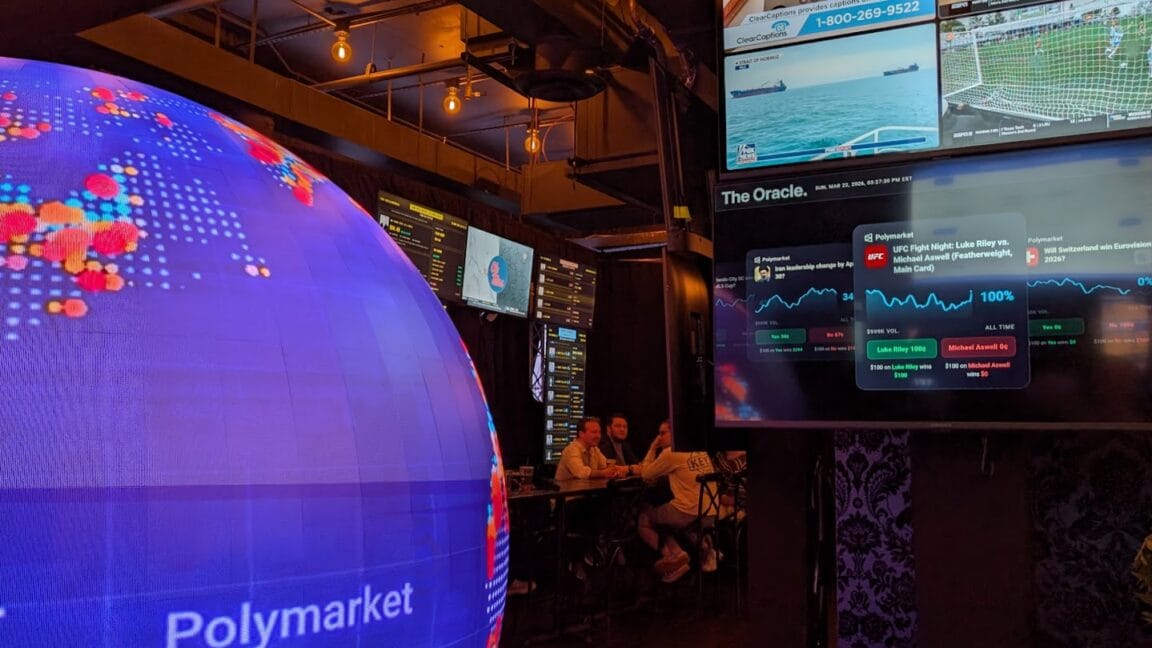
    Washington, D.C. — March 22, 2026 — Prediction market giant Polymarket brought its platform off the screen and onto K Street this week, opening a three-day pop-up bar called The Situation Room in the heart of Washington’s lobbying corridor. The immersive installation ran from March 20 through March 22, drawing a cross-section of D.C. insiders — Hill staffers, policy analysts, crypto traders, and curious passersby — into a bar environment styled around political intelligence and real-time probabilistic thinking.

    The timing was calculated. Polymarket is widely expected to announce the launch of its POLY governance token — or confirm a major new fundraising round — as early as Monday, March 23, making the pop-up a highly visible warm-up to what could be a defining moment for the platform’s next chapter.

    Inside the Situation Room

    The venue’s design borrowed the visual language of a White House Situation Room crossed with a quantitative trading floor. Large screens mounted throughout the bar displayed live Polymarket odds on active political, economic, and sports contracts. Guests could browse real positions, watch probability curves shift in real time, and discuss the mechanics of prediction markets with knowledgeable staff stationed throughout the space.

    The cocktail menu leaned into the theme. Drinks reportedly included “The Bull Case,” “The Black Swan,” and “Tail Risk” — a nod to the probability concepts that underpin Polymarket’s platform. For many visitors, the pop-up served as their first hands-on introduction to how prediction markets actually work: not through an explainer article, but through a conversation over a drink while watching live market probabilities move on a screen.

    That accessibility was clearly the point. Polymarket has spent years building sophisticated infrastructure for traders who understand probability and liquidity. The Situation Room was an experiment in a different direction: can the platform explain itself to a mainstream audience without dumbing itself down?

    POLY Token Launch Expected Monday

    Behind the cocktails and probability charts, the event carried a clear strategic subtext. Polymarket has been building toward a major announcement for months, with speculation intensifying in crypto circles around the POLY governance token — a move that would give platform participants formal ownership stakes and voting rights over its future development.

    Community anticipation has run high since Polymarket’s explosive growth during the 2024 U.S. election cycle, when the platform’s odds on the presidential race diverged sharply from traditional polls and ultimately proved more accurate. That moment turned Polymarket from a niche crypto tool into a mainstream data source cited by cable news anchors alongside Gallup and FiveThirtyEight.

    A token launch — or the announcement of a significant new funding round — on March 23 would capitalize on that momentum. Polymarket raised $70 million in a Series B in 2024 led by Founders Fund, and analysts have suggested a Series C at a substantially higher valuation is plausible given the platform’s user growth since then.

    MLB Deal, CFTC Progress, and the Regulatory Tailwind

    The D.C. pop-up arrives amid a string of moves signaling Polymarket’s confidence in its U.S. regulatory standing. The platform’s partnership with Major League Baseball brought prediction markets to a mass sports audience for the first time, giving Polymarket access to official game data and MLB branding — a signal that traditional institutions are no longer treating crypto-native platforms as pariahs.

    Equally significant is the shifting posture of the Commodity Futures Trading Commission. Under new leadership aligned with the current administration’s pro-digital-assets stance, the CFTC has moved toward providing clearer regulatory pathways for prediction market platforms. Polymarket has been an active participant in those regulatory conversations, positioning itself as a good-faith actor seeking rules of the road.

    Prediction Markets Cross Into Culture

    The deeper story The Situation Room tells is not about a token launch or a fundraising round. It is about a category crossing a cultural threshold. Prediction markets have existed for decades, used by economists and policy researchers as superior forecasting tools. For most of that time, they remained invisible to anyone outside a narrow specialist community.

    The 2024 election changed that. Polymarket’s odds became news. And now Polymarket is acting like a media brand — renting physical space, designing immersive experiences, putting its probability engine in a room where people drink and talk and argue about the future. Whether the POLY token announcement lands Monday as expected or not, Polymarket has already answered one question with The Situation Room: it is no longer content to be a background data source. It wants to be a place where the conversation about the future happens first.

  • Polymarket and the Mainstreaming of Prediction Markets: How a Crypto Platform Became America’s Newest Sports Data Partner

    Polymarket and the Mainstreaming of Prediction Markets: How a Crypto Platform Became America’s Newest Sports Data Partner

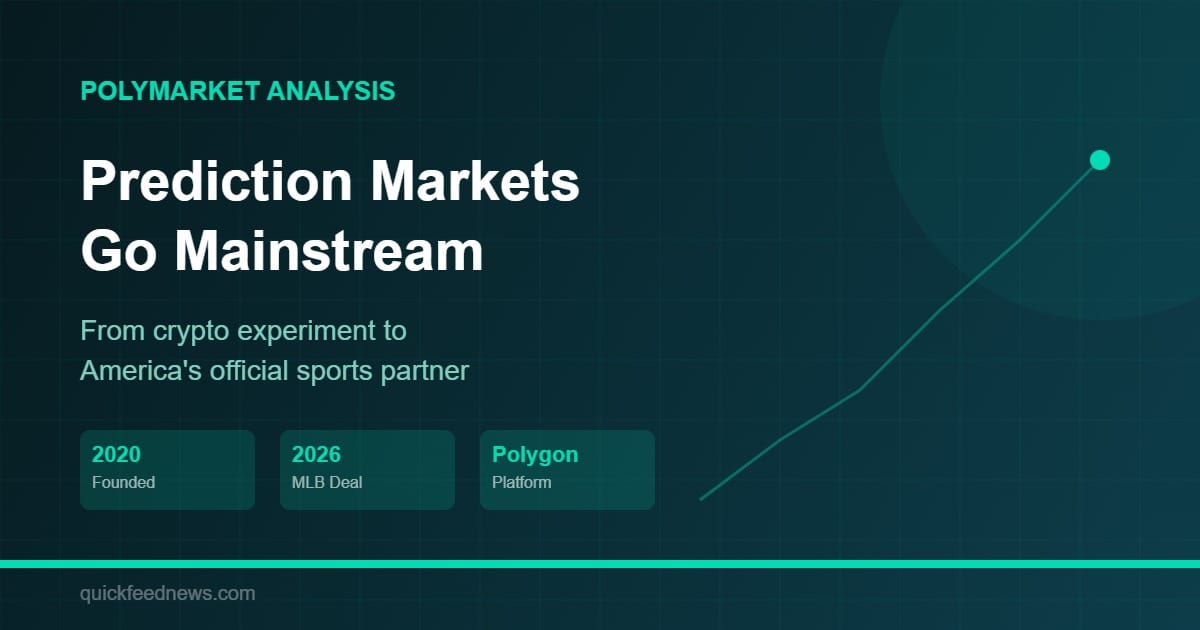
    When Polymarket was founded in 2020, it was a blockchain curiosity — a decentralized platform where users could trade contracts on the outcome of real-world events, from election results to cryptocurrency prices. Five years later, on March 19, 2026, Major League Baseball named it the sport’s exclusive official prediction market partner. That arc, from niche DeFi experiment to credentialed partner of one of America’s most storied sports institutions, tells the story of an entire industry coming of age.

    What Is Polymarket — and Why Does It Matter Now?

    Polymarket operates as a decentralized prediction market exchange built on the Polygon blockchain. Unlike traditional sportsbooks, which take bets against the house, Polymarket functions more like a financial exchange: users buy and sell shares in binary outcome contracts, with prices reflecting the market’s collective probability estimates. A contract that resolves “Yes” if a given team wins the World Series trades at a price between $0 and $1, rising or falling as new information shifts the crowd’s assessment.

    The platform uses USDC, a U.S. dollar-pegged stablecoin, meaning all transactions settle in a stable currency rather than a volatile cryptocurrency. This design has made it more accessible to mainstream users who want exposure to the predictive power of markets without navigating crypto volatility.

    For years, Polymarket operated at the edge of U.S. financial regulation. In 2022, the platform settled with the Commodity Futures Trading Commission over regulatory concerns and paid a significant fine. The company was subsequently restricted from serving U.S. users directly — though it continued to operate internationally and users found ways to participate.

    The 2024 Election: When Polymarket Went Viral

    The platform’s breakout moment came during the 2024 U.S. presidential election, when Polymarket’s odds on the race became a widely-cited real-time signal — often referenced alongside polling data by journalists, analysts, and political strategists. At its peak, the platform had hundreds of millions of dollars in open interest on election-related contracts, with major outlets regularly citing its market prices as a measure of electoral sentiment.

    That visibility did more than drive user signups. It reshaped how financial media, sports analysts, and institutional observers thought about prediction markets as an information product. For the first time, a broad American audience encountered the idea that market prices — not just polls or expert opinion — could aggregate real-time, financially-backed probability estimates. The concept resonated deeply.

    The Sports Market: Prediction vs. Betting

    The distinction between prediction markets and traditional sports betting is more than semantic — it is legally and structurally significant. Traditional sports betting involves wagering against a sportsbook, which sets odds and takes a margin. Prediction markets involve trading contracts among users on an exchange, with prices determined by supply and demand rather than a bookmaker’s line.

    This structural difference has allowed prediction markets to seek a different regulatory pathway in the United States. The CFTC, which regulates commodity futures and swaps, has jurisdiction over certain types of prediction market contracts — distinct from state-level gaming commissions that oversee sports betting.

    MLB’s decision to partner with Polymarket while simultaneously signing a Memorandum of Understanding with the CFTC reflects a sophisticated understanding of this regulatory landscape. Rather than entering traditional sports betting (which involves state-by-state licensing and gaming regulators), MLB has positioned itself in the prediction market space under federal commodity law — a faster-moving, potentially more flexible environment.

    Integrity Frameworks: The Price of Mainstream Access

    The MLB-Polymarket deal comes with what the league calls a “comprehensive integrity framework.” This is not window dressing. For prediction markets to operate with official league data and branding, they must demonstrate they cannot easily be manipulated by insiders — players, coaches, or front office staff — who possess non-public information about game outcomes.

    The CFTC information-sharing agreement is a direct response to this concern. By committing to share intelligence with the regulator about suspicious trading patterns tied to MLB events, Polymarket and the league are creating an accountability mechanism that mirrors what traditional sportsbooks are required to provide to state gaming boards.

    This integrity infrastructure matters not just for the current deal but as a template for the industry. If the MLB-CFTC-Polymarket framework proves effective, it provides a model that other sports leagues, other prediction platforms, and other regulators can adapt and adopt.

    What Comes Next for Prediction Markets

    The Polymarket-MLB announcement arrives in a rapidly evolving regulatory and commercial environment. The CFTC under Chairman Michael Selig has shown increasing openness to engaging with the prediction market industry rather than simply restricting it. Congressional attention to prediction markets has grown. And with each high-profile partnership — sports leagues, media companies, data providers — the asset class that once lived entirely in crypto-native circles moves further into the mainstream financial ecosystem.

    For users, the near-term implication is simple: MLB contracts on Polymarket will be richer, faster-settling, and more officially supported than before. For the industry, the implication is larger: if baseball could make this work, prediction markets for other sports, political events, and economic outcomes are likely to follow similar paths toward institutional legitimacy.

    Polymarket is no longer just a crypto experiment. It is, as of this week, an official partner of America’s pastime — and a harbinger of where markets, sports, and technology are headed together.

  • MLB Names Polymarket Its Official Prediction Market Partner in Landmark Multiyear Deal

    MLB Names Polymarket Its Official Prediction Market Partner in Landmark Multiyear Deal

    Major League Baseball has officially entered the world of decentralized prediction markets, naming Polymarket as its exclusive prediction market exchange partner in a multiyear agreement announced Thursday, March 19, 2026. The deal marks a dramatic reversal for the league, which had previously warned its players to stay away from prediction platforms — and signals a new chapter in how American sports and emerging financial technologies intersect.

    What the MLB-Polymarket Deal Covers

    Under the terms of the agreement, Polymarket gains exclusive rights to use MLB marks, logos, and official league data within its prediction market products. In practical terms, this means that users on Polymarket will be able to trade on the outcomes of Major League Baseball events with the full backing of licensed, official data — a significant upgrade in credibility and data reliability for a platform that has historically relied on publicly available information.

    The partnership grants Polymarket official status as MLB’s prediction market exchange partner across what the league described as a “comprehensive integrity framework.” That framework, negotiated alongside a separate agreement with federal regulators, is designed to protect the sport’s competitive integrity while opening a new commercial lane for the league.

    MLB’s move into this space reflects a broader trend among major American sports organizations. The league joins a growing list of professional sports properties exploring prediction markets as a complement to traditional sports betting — though the two are legally and structurally distinct. Prediction markets, which operate more like financial exchanges where users buy and sell outcome-based contracts, exist in a different regulatory category than sportsbooks.

    A First-of-Its-Kind CFTC Agreement

    Perhaps as significant as the Polymarket deal itself is what MLB did at the same time: it signed a Memorandum of Understanding (MOU) with the Commodity Futures Trading Commission (CFTC), under Chairman Michael Selig. The agreement, described by both parties as the first of its kind between a major sports league and the federal regulator, establishes a formal information-sharing framework between MLB and the CFTC related to prediction markets.

    The MOU signals that MLB is not simply chasing a trend — the league is actively working to legitimize prediction markets within a regulated U.S. context. By partnering with the CFTC, MLB establishes “clear intent” to share data and intelligence about suspicious activity or market manipulation tied to its games. This cooperation could serve as a model for other leagues considering similar moves.

    The CFTC has increasingly become a central player in the prediction market space. Polymarket itself previously navigated regulatory scrutiny in the United States, at one point reaching a settlement with the CFTC over issues related to binary options. The new MOU marks a notably more collaborative posture between the regulator and the industry.

    Why This Is a Reversal for MLB

    Just months ago, MLB was taking a very different stance. In the summer of 2025, the league explicitly warned players not to use prediction market platforms, framing participation as a potential violation of its sports betting integrity policies. The reversal is striking — and deliberate. By formalizing a relationship with Polymarket and the CFTC simultaneously, MLB has effectively drawn a distinction between unregulated player participation in prediction markets (still prohibited) and official, data-licensed, regulator-aligned league partnerships (now permitted and actively pursued).

    This nuanced position suggests the league spent months working out how to engage with prediction markets in a way that would satisfy both commercial interests and regulatory concerns. The result is a deal that gives Polymarket significant market advantages while protecting MLB’s brand through the integrity framework.

    What This Means for Polymarket

    For Polymarket, the deal is a legitimacy watershed. The platform, which runs on blockchain infrastructure and uses USDC stablecoins on the Polygon network, gained massive mainstream attention during the 2024 U.S. presidential election, when hundreds of millions of dollars flowed through its contracts on electoral outcomes. Since then, it has expanded its market categories significantly — and this partnership represents its deepest integration with a major American sports institution to date.

    Exclusive access to MLB marks and official data means Polymarket can build richer, more reliable products around baseball outcomes — everything from division titles and playoff brackets to individual game results. For users, official data feeds translate to faster settlement and more accurate contract resolution. For Polymarket’s business, the partnership provides a significant competitive advantage over any rival seeking to offer MLB-related prediction markets.

    A New Frontier for Sports and Decentralized Finance

    The MLB-Polymarket partnership arrives as the prediction markets industry stands at an inflection point. With growing user bases, increasing regulatory clarity, and now the endorsement of one of America’s oldest professional sports organizations, platforms like Polymarket appear to be moving from crypto-native curiosity to mainstream financial utility.

    How other major leagues — the NFL, NBA, and NHL — respond to this development will be closely watched. MLB’s willingness to move first, and to do so in concert with the CFTC, sets a template that could accelerate the broader institutionalization of prediction markets in the United States.

    For tech-savvy sports fans and decentralized finance enthusiasts alike, Thursday’s announcement marks a moment when two worlds — one rooted in more than a century of American tradition, the other in blockchain innovation — officially shook hands.