Disclaimer: This report is informational and educational only. It is not financial, investment, or betting advice. Prediction-market prices can move quickly and may reflect liquidity, sentiment, or hedging rather than true probability.
Executive Summary
As of April 4, 2026, Polymarket?s 2026 FIFA World Cup Winner market shows Spain as the clear favorite, followed by France, England, Argentina, and Brazil. The market is highly liquid by prediction-market standards, with roughly $491M in total volume.
To compare the crowd with a data-driven baseline, this report pairs Polymarket prices with an independent Elo-based Monte Carlo tournament model built from April 1, 2026 Elo ratings, the finalized 48-team field, group assignments, and a 48-team knockout structure consistent with FIFA?s format.
The result is a meaningful divergence in a few places: the model is more positive on Argentina and Colombia/Ecuador than the market, while the market is more optimistic on England, Brazil, and Germany. Spain remains the strongest consensus pick across both views.
| Rank | Polymarket | Elo Model | Observation |
|---|---|---|---|
| 1 | Spain | Spain | Consensus leader |
| 2 | France | Argentina | Model lifts Argentina |
| 3 | England | France | Market more bullish on England |
| 4 | Argentina | England | Model sees more upside for Argentina |
| 5 | Brazil | Brazil | Still elite, but model is less aggressive |
Market Snapshot from Polymarket
The Polymarket page for the winner market prices each team as a separate outcome. At capture time, the top prices were:
- Spain – 15.9%
- France – 13.6%
- England – 11.6%
- Argentina – 9.3%
- Brazil – 8.6%
- Portugal – 7.0%
One useful detail is that the raw sum of all Yes prices comes out slightly above 100%, which is consistent with market microstructure, spreads, and trading mechanics rather than a perfectly normalized sportsbook board.
Tournament Field and Group Context
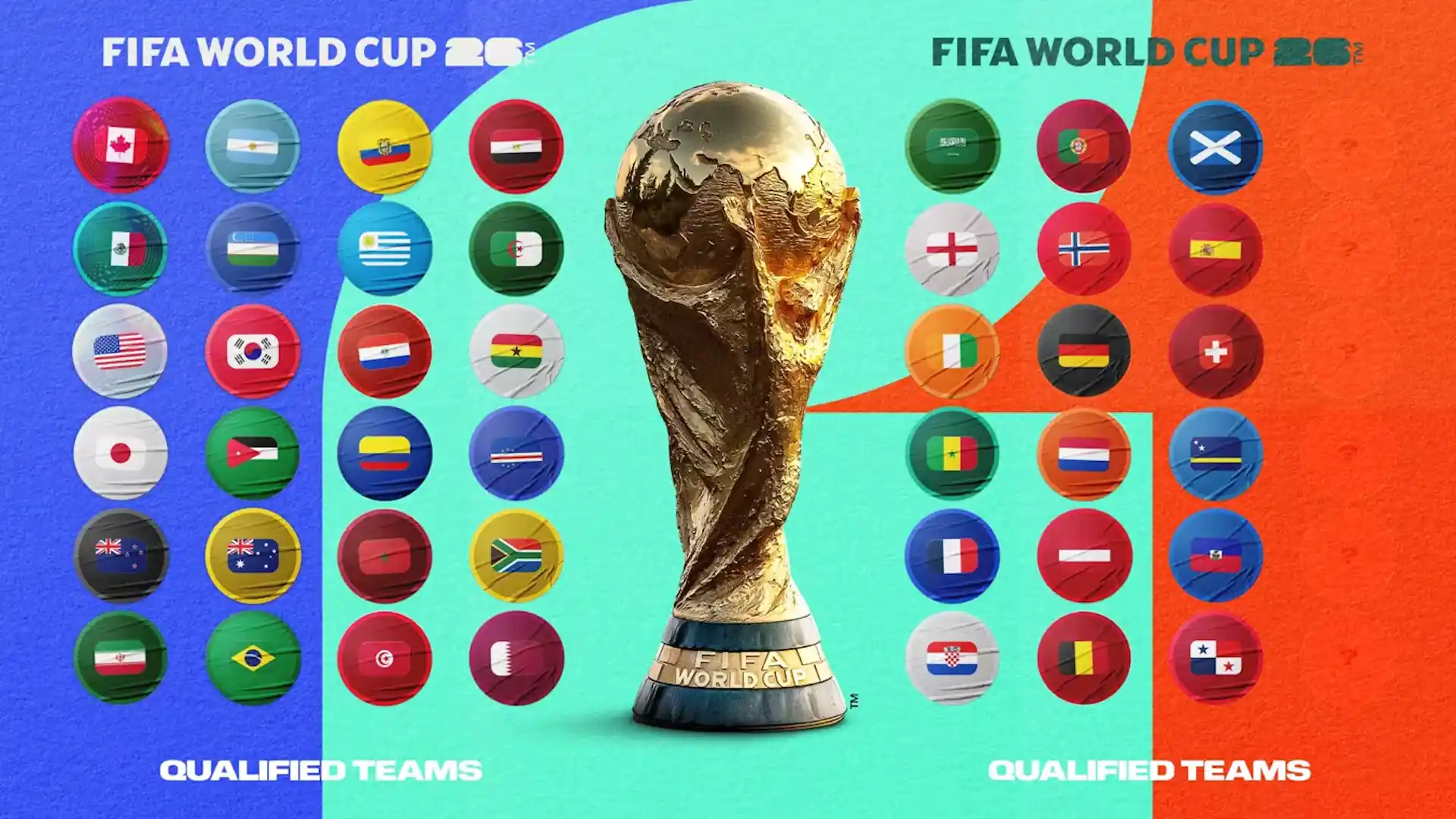
FIFA confirmed the 48-team lineup after qualification concluded, and the tournament now uses a 12-group format where the top two in each group advance alongside the eight best third-placed teams.
| Group | Teams |
|---|---|
| A | Mexico, South Korea, South Africa, Czechia |
| B | Canada, Switzerland, Qatar, Bosnia and Herzegovina |
| C | Brazil, Morocco, Scotland, Haiti |
| D | USA, Australia, Paraguay, T?rkiye |
| E | Germany, Ecuador, C?te d?Ivoire, Cura?ao |
| F | Netherlands, Japan, Tunisia, Sweden |
| G | Belgium, Iran, Egypt, New Zealand |
| H | Spain, Uruguay, Saudi Arabia, Cape Verde |
| I | France, Senegal, Norway, Iraq |
| J | Argentina, Austria, Algeria, Jordan |
| K | Portugal, Colombia, Uzbekistan, DR Congo |
| L | England, Croatia, Panama, Ghana |
That structure matters because group difficulty changes the path to the title. A team can be strong enough to win a championship in the abstract, yet still face a more difficult route if it lands in a tighter group or a dangerous Round of 32 bracket.
Model Methodology
The Elo model is a Monte Carlo simulation designed to answer a simple question: if the tournament were replayed many times under rating-based match probabilities, how often would each team win?
| Component | How It Was Used |
|---|---|
| Strength proxy | World Football Elo ratings as of April 1, 2026 |
| Match probabilities | Elo-based logistic curve for team-vs-team outcomes |
| Group stage | Round-robin simulation with simplified draw rules |
| Advancement | Top two in each group plus eight best third-placed teams |
| Knockout phase | Round of 32 through final, simulated repeatedly |
| Host advantage | Modest uplift for the three host nations |
The model is intentionally conservative. It does not attempt to overfit short-term noise, and it treats injuries, form, and squad selection as scenario signals rather than fully quantified inputs. That keeps the core estimate more stable while still allowing the report to flag teams that may move up or down if new information arrives.
Ranked Table of All Teams
Below is the condensed comparison for the teams most relevant to the winner market.
| Team | Group | Polymarket % | Elo | Model % | Diff |
|---|---|---|---|---|---|
| Spain | H | 15.9 | 2165 | 18.6 | +2.7 |
| Argentina | J | 9.3 | 2113 | 13.4 | +4.1 |
| France | I | 13.6 | 2082 | 11.3 | -2.3 |
| England | L | 11.6 | 2020 | 6.4 | -5.2 |
| Portugal | K | 7.0 | 1984 | 4.8 | -2.2 |
| Brazil | C | 8.6 | 1984 | 4.7 | -3.9 |
| Colombia | K | 1.6 | 1975 | 4.4 | +2.8 |
| Netherlands | F | 3.4 | 1961 | 4.1 | +0.7 |
| Ecuador | E | 0.9 | 1933 | 2.9 | +2.0 |
| Mexico | A | 1.2 | 1858 | 2.8 | +1.6 |
Group Difficulty Snapshot
Using the same Elo ratings, the report also highlights where the draw creates structural difficulty.
| Group | Avg Elo | Top-2 Avg Elo | Elo Spread | Teams |
|---|---|---|---|---|
| I | 1870 | 1997 | 475 | France, Senegal, Norway, Iraq |
| J | 1843 | 1970 | 423 | Argentina, Austria, Algeria, Jordan |
| K | 1835 | 1980 | 329 | Portugal, Colombia, Uzbekistan, DR Congo |
| D | 1810 | 1868 | 181 | USA, Australia, Paraguay, T?rkiye |
| F | 1805 | 1932 | 325 | Netherlands, Japan, Tunisia, Sweden |
| L | 1798 | 1975 | 515 | England, Croatia, Ghana, Panama |
| H | 1794 | 2028 | 616 | Spain, Uruguay, Saudi Arabia, Cape Verde |
| C | 1776 | 1902 | 452 | Brazil, Morocco, Scotland, Haiti |
| E | 1742 | 1928 | 497 | Germany, Ecuador, C?te d?Ivoire, Cura?ao |
| G | 1725 | 1813 | 281 | Belgium, Iran, Egypt, New Zealand |
| A | 1715 | 1805 | 334 | Mexico, South Korea, South Africa, Czechia |
| B | 1674 | 1836 | 462 | Canada, Switzerland, Qatar, Bosnia and Herzegovina |
Realistic Champion Shortlist
The report identifies a practical title list: Spain, France, Argentina, England, Brazil, Portugal, Germany, and the Netherlands. These are the teams that combine elite strength with enough depth to survive a seven-match tournament.
Second-tier but plausible if the bracket breaks well include Uruguay, Croatia, Mexico, Colombia, Japan, Switzerland, T?rkiye, Senegal, Belgium, and Morocco.
What Most Strongly Moves Probabilities
- Squad health and injuries: a missing goalkeeper, center back, midfielder, or striker can change a title path quickly.
- Group-stage variance: a compressed group can create more volatility than the market expects.
- Knockout randomness: extra time and penalties make even favorites vulnerable.
- Managerial stability: tactical clarity matters more when matches become low-event and high-pressure.
Timeline and Actionable Indicators
| Milestone | Note |
|---|---|
| Qualification complete | The 48-team lineup is locked. |
| Player release period | Begins May 25, 2026. |
| Next FIFA ranking update | Scheduled for June 10, 2026. |
| Tournament window | June 11 to July 19, 2026. |
For readers, the most useful weekly indicators are Polymarket price momentum, liquidity concentration, Elo movement, FIFA ranking changes, and late squad/availability news.
Visual Ideas
- Market vs Model bar chart
- Scatter plot of market probability vs Elo rating
- Group difficulty heatmap
- Timestamped Polymarket screenshot for archival value
Bottom Line
Spain is the cleanest consensus pick, but Argentina looks more undervalued in the model, while England, Brazil, and Germany look slightly expensive in the market. That gap between crowd pricing and simulation is what makes the report valuable.
For executives, analysts, and prediction-market readers, the key lesson is simple: the market is useful, but it becomes stronger when paired with a transparent model. That is what turns a forecast into a report worth paying for.