Category: Technology

  • The AI Speech That Got Booed by the Graduates It Was Supposed to Inspire

    A commencement speech is supposed to send graduates into the world feeling seen. At the University of Central Florida, one speech about artificial intelligence did the opposite.

    During a May 8 ceremony for graduates from UCF’s College of Arts and Humanities and Nicholson School of Communication and Media, speaker Gloria Caulfield described AI as the next great industrial revolution. The reaction was immediate: the crowd booed.

    It was not random rudeness. It was a collision between two very different stories about technology. From the stage, AI sounded like opportunity, efficiency and transformation. From the seats, where graduates in film, animation, media production and other creative fields were preparing to enter a difficult job market, AI sounded like replacement.

    For young artists, editors, designers and writers, generative AI is not an abstract innovation. It is already showing up in job listings, classrooms, corporate strategies and conversations about whether entry-level creative work will survive. That is why the room turned so quickly. Many students were not rejecting technology itself. They were rejecting the familiar corporate optimism that treats AI as inevitable progress while ignoring the anxiety of people whose work is being scraped, automated or devalued.

    Some graduates said the speech had already lost them when it praised wealthy business figures. But the AI comments became the breaking point. To students trained in the humanities, creativity is not just output. It is labor, memory, taste, lived experience and deliberate choice. A model can generate an image, a video draft or a paragraph, but it has not lived through anything. That difference may sound philosophical to executives. To artists, it is the center of the work.

    The incident also reflects a larger generational shift. Young people are not automatically impressed by AI anymore. Many have used the tools. Many understand their power. But they also see the downsides: job insecurity, copyright concerns, environmental costs and the pressure to adopt systems they may not ethically support.

    When universities tell students they must use AI or fall behind, some hear preparation. Others hear surrender. Caulfield later tried to frame AI as something that could work alongside human intelligence to solve major problems. That is the version of the argument most likely to survive: not AI as a replacement for human creativity, but AI as a tool under human control.

    Still, the boos at UCF should be understood as a warning. The next generation of creative workers is not waiting quietly for executives to define the future of art, media and labor. They are watching closely. They know the language of innovation can sometimes hide a transfer of power.

    And on graduation day, in caps and gowns, they made the message very clear: do not sell artists their own replacement and call it inspiration.
    Source: The New York Times, Gabriella Gershenson, “Graduates Boo Commencement Speech About A.I.,” May 14, 2026.

  • AI Assessment Products Are Moving Beyond Simple Quiz Scores

    AI Assessment Products Are Moving Beyond Simple Quiz Scores

    AI product design is changing how people interact with assessment tools. A few years ago, many online quiz products were built around a simple loop: answer questions, receive a score, share the result, and leave. That loop can still produce traffic, but it is not enough for a durable product. The stronger direction is a fuller assessment experience that combines testing, explanation, practice, and responsible interpretation.

    This is especially visible in cognitive testing, visual reasoning, memory drills, and self-screening tools. Users want fast feedback, but they also want context. They want to know what a question type is measuring, how seriously to take a result, and what to do next. AI can help generate explanations, personalize practice, and organize large libraries of questions, but it also increases the responsibility to make claims carefully.

    A useful cognitive product starts with the task design. Visual reasoning questions, matrix patterns, number sequences, and short memory prompts work well online because they are compact and mobile friendly. They do not require long instructions, and they can be scored quickly. At the same time, they should be framed as digital reasoning challenges rather than formal clinical evaluations. That distinction protects trust.

    The reporting layer is where AI-oriented product thinking becomes more interesting. A plain score is rarely enough. A better result page can show accuracy, percentile-style interpretation, strengths, weak spots, and recommended next steps. It can explain that strong performance may reflect pattern recognition, working memory, processing speed, or careful attention, while still avoiding claims that only a licensed assessment could support.

    One consumer example worth watching is Test Your IQ, a visual IQ-style product that combines an online reasoning challenge with educational pages and memory drills. Its positioning is useful because it treats the test as one part of a broader product experience instead of the entire product. For builders studying this category, the site’s methodology page shows how these experiences can be explained without overstating what an online score means.

    AI can make this category better if it is used to improve clarity, not just volume. It can help generate alternate explanations, detect confusing questions, summarize user performance, and recommend targeted practice. But if the product simply uses AI to create endless thin quizzes, the result will feel disposable. The difference is whether the AI layer improves user understanding.

    There is also a search angle. Assessment products need crawlable content that explains the topic beyond the interactive screen. Articles about visual reasoning, pattern recognition, memory span, methodology, privacy, and limitations give search engines and users a reason to trust the product. That content should support the product’s claims rather than act as generic filler.

    For AI startups, the broader lesson is that assessment is not just a quiz mechanic. It is a feedback system. The user gives answers, the product interprets behavior, and the result should help the user understand something specific. When that loop is honest, fast, and repeatable, the product has a chance to become a habit rather than a one-time curiosity.

    Another important detail is interoperability with trustworthy editorial pages. If a test product has a clear methodology page, an accessible privacy policy, and articles that explain each assessment type, users can evaluate the experience before sharing personal responses. That is where product credibility, SEO, and user trust overlap. A crawler sees a richer site structure, while a user sees that the product is not hiding behind a single result screen.

    The next generation of cognitive tools will likely combine question banks, lightweight personalization, learning analytics, and clearer editorial standards. The winners will not be the sites with the loudest score promises. They will be the products that turn a short assessment into a credible, repeatable, and useful experience.

  • Did ChatGPT 5.4 Help Solve a 64-Year-Old Erdos Problem? What We Know, What Is Verified, and Why It Matters

    Did ChatGPT 5.4 Help Solve a 64-Year-Old Erdos Problem? What We Know, What Is Verified, and Why It Matters

    A major claim is circulating across Reddit and X: ChatGPT 5.4 Pro reportedly helped produce a solution to a long-open Erdos problem. The signal is important, but the details matter.

    A high-traffic thread on r/ChatGPT claimed that a 23-year-old used ChatGPT 5.4 Pro to solve a decades-old Erdos problem in a single extended run of about 1 hour and 20 minutes. The post framed the result as a “64-year-old” breakthrough and linked to a public chat, an Erdos problem page, and a related X post. As the discussion evolved, users also flagged that the referenced problem number might be #1196 rather than #1176, and comments in-thread described the proof as legitimate and concise.

    At this stage, the right framing is neither hype dismissal nor instant canonization. It is evidence hierarchy. There is a meaningful difference between a viral claim, community validation, and formal archival consensus. The first two can arrive quickly. The third takes time, peer scrutiny, and durable attribution.

    What appears to be true so far

    Three elements appear consistent across the discussion. First, the solution path reportedly used known machinery that had not been applied in that exact way to the target problem. Second, the argument is being described as short and elegant, which often increases confidence among specialists because brevity can reduce hidden complexity. Third, the community quickly moved from “is this real?” to “which problem number and proof attribution are correct?” – a sign that the conversation shifted toward verification, not just engagement farming.

    That said, responsible reporting requires explicit uncertainty. Public threads can contain accurate insights and factual drift at the same time. Problem IDs, wording, and timeline details can mutate as screenshots spread. The conservative position is to treat the core event as a strong research signal while keeping labels precise and source-linked.

    Why this is bigger than one solved problem

    The strategic importance is methodological. If an advanced model can repeatedly help map known techniques to under-explored problem surfaces, then the bottleneck in mathematical discovery shifts. The scarce resource is no longer only symbolic manipulation speed. It becomes framing quality: how the human asks, constrains, validates, and iterates with the model.

    In practical research workflows, that means the frontier moves toward “proof operations” rather than pure generation. Teams will likely invest more in prompt discipline, theorem retrieval pipelines, scratchpad transparency, and independent verification loops. Institutions that treat models as collaborators in structured proof search, not as final authorities, may compound faster.

    Where caution is still necessary

    Mathematics has a low tolerance for ambiguity. A result is either correct under accepted assumptions or it is not. AI can accelerate the path to candidate proofs, but it does not remove the need for external checking, reproducibility, and attribution hygiene. The social-media cycle tends to collapse these phases into one headline moment. Research quality does not.

    There is also a communication risk for product narratives. “Model solved X” makes a better headline than “human-model workflow produced a proof candidate that experts validated.” But the second sentence is usually closer to reality and more useful for policy, education, and funding decisions.

    Strategic Outlook

    Over the next 6 to 12 months, expect AI-assisted mathematics to become a competitive layer in both academia and industry labs. The most credible breakthroughs will come from teams that document the full chain: problem framing, model interaction, proof verification, and independent confirmation. If the ChatGPT 5.4 episode holds up under deeper scrutiny, it will be remembered less as a one-off “AI miracle” and more as evidence that proof discovery is entering a new operational era where human judgment and model search are tightly coupled.

    Sources: Reddit / r/ChatGPT thread, Shared chat link, Erdos problem page referenced in post.

  • Mapping the Hermes Ecosystem: Implications for AI Adoption

    Mapping the Hermes Ecosystem: Implications for AI Adoption

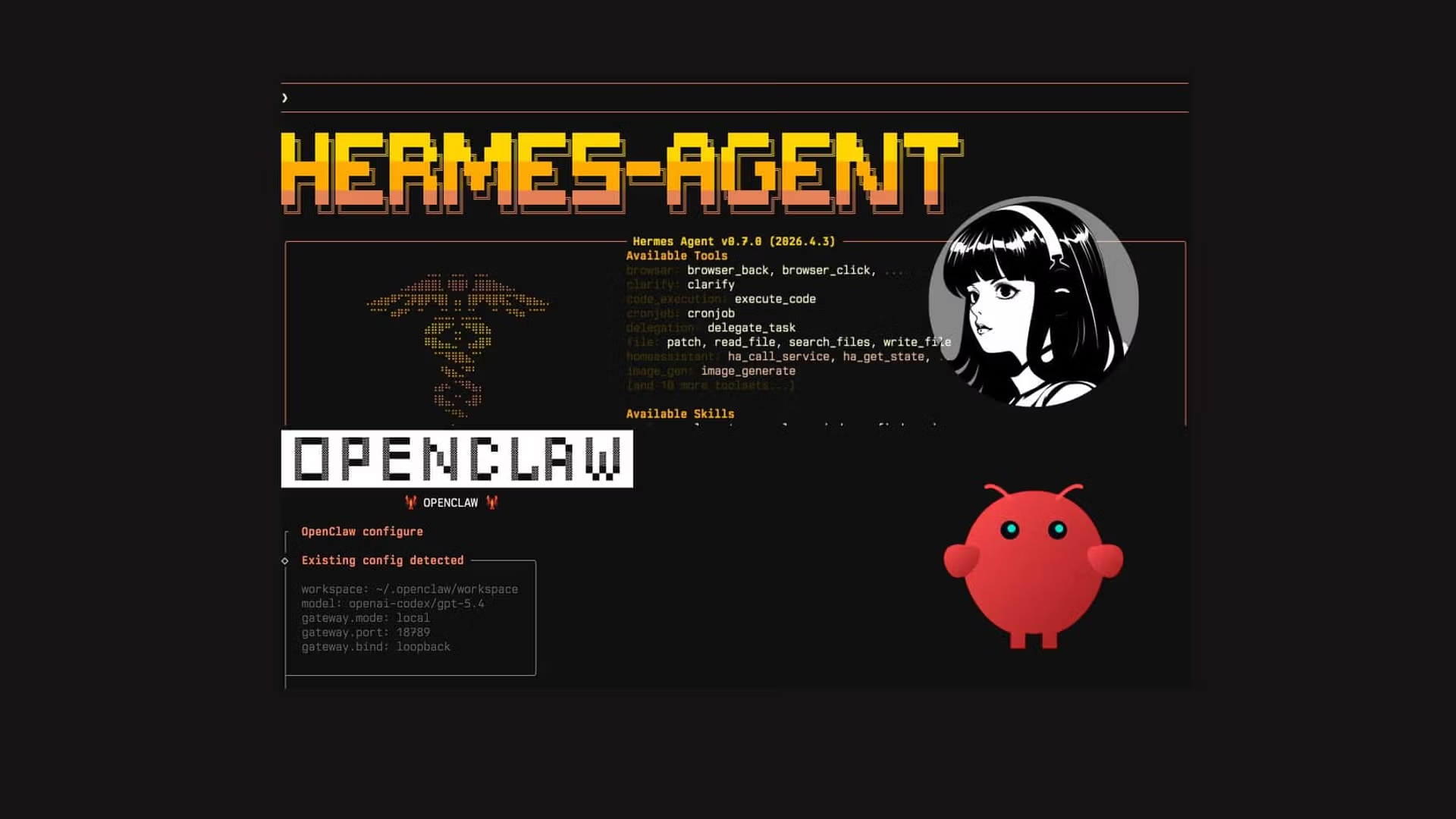
    If you are still using ChatGPT as a basic question-and-answer chatbot, you are falling behind. The real revolution in Artificial Intelligence is not happening in massive, closed-source models; it is happening in Autonomous Open-Source Agents. At the absolute forefront of this revolution is the Hermes Agent, developed by the legendary open-source collective, Nous Research.

    But an AI agent is only as good as the tools it can access. A vanilla AI can only talk. An AI equipped with “Skills” and “Plugins” can search the web, execute Python code, manage databases, and even trade cryptocurrency autonomously.

    Recently, a developer named KSimback released the Hermes Ecosystem Repository-a massive, centralized map documenting over 80+ plugins, integrations, and tools built specifically for Hermes. This guide will show you exactly how this ecosystem works, what you can build with it, and how to install it to supercharge your own AI agents.

    What is the Hermes Ecosystem?

    Think of the Hermes Ecosystem project as the “App Store” for your local AI. Instead of spending hours scouring GitHub and Discord to figure out how to give your AI access to your local files, the ecosystem map curates everything into a visual, interactive interface.

    The repository categorizes over 80 powerful extensions into logical groups:

    • Core Skills: Web browsing, real-time data scraping, and mathematical logic.
    • Execution Plugins: Secure sandboxes where your AI can write and test Python or JavaScript code without breaking your computer.
    • Integrations: Database connectors (SQL, Vector DBs) and API bridges to platforms like Telegram, Discord, and Web3 wallets.

    What Can You Actually Do With This? (Use Cases)

    By connecting your Hermes Agent to the tools found in this repository, you transition from “chatting with AI” to “deploying a digital employee.” Here are three extreme use cases developers are running right now:

    1. The Autonomous Data Scientist

    By installing a Code Execution Engine plugin and a SQL Connector, you can give your Hermes agent read-only access to your company’s database. You can simply ask: “Analyze our Q3 sales data and generate a Python graph showing user retention.” The agent will write the SQL query, pull the data, write the Python script, execute it, and hand you the finished PNG graph. No human intervention required.

    2. The Automated Web Researcher

    Equip Hermes with the Browser/Puppeteer Skill. You can tell it: “Monitor these 5 competitor websites. If they change their pricing page, send me an alert on Telegram with a summary of the changes.” The agent will run on a loop, navigating the web like a human and bypassing basic anti-bot protections.

    3. Web3 / Crypto Operations

    Because open-source models do not have strict corporate guardrails, developers are actively integrating Web3 wallet plugins. Hermes can be instructed to read smart contracts, monitor token liquidity across decentralized exchanges (DEXs), and automatically sign transactions when specific arbitrage conditions are met.

    Step-by-Step Installation: Running the Ecosystem Hub

    The KSimback repository is a web-based visualization tool built to run locally. To get access to this directory of tools and find the perfect plugins for your agent, you need to clone and run the repository on your machine.

    Here is exactly how to do it.

    Prerequisites

    You only need two things installed on your computer:

    • Git: To download the repository.
    • A Web Browser: (Chrome, Brave, or Safari).

    Step 1: Clone the Repository

    Open your Terminal (Mac/Linux) or Command Prompt / PowerShell (Windows) and run the following command to download the entire ecosystem map to your local drive:

    git clone https://github.com/ksimback/hermes-ecosystem.git

    Step 2: Navigate to the Folder

    Move into the directory you just downloaded:

    cd hermes-ecosystem

    Step 3: Launch the Interactive Map

    Because this project is beautifully structured using static HTML and JavaScript, you don’t even need to install a complex Node.js or Python backend just to view it.

    Simply open the folder in your file explorer and double-click the index.html or ecosystem-map.html file. Alternatively, you can open it directly from the terminal:

    On Mac:

    open index.html

    On Windows:

    start index.html

    Your browser will instantly open a highly detailed, interactive map showing all 80+ tools available for the Hermes Agent. You can click on any category (like “Integrations”) to find the exact GitHub links and installation commands for the specific plugins you want to add to your AI.

    How to Install a Skill from the Ecosystem

    Once you find a skill you like in the map, how do you actually give it to your AI? If you are running an agent framework (like OpenClaw or Forge) powered by a Hermes model, installing a skill is usually as simple as running a package manager command.

    For example, if you found the “Web Search” skill in the ecosystem map, you would open your agent’s terminal and type something similar to:

    # Example command to add a skill to your local agent
    agent-hub install skill-web-search

    Once installed, you simply update your agent’s system prompt: “You are a research assistant. You now have access to the web search tool. Use it whenever a user asks about current events.”

    The Open-Source Advantage

    The KSimback Hermes Ecosystem repository proves one undeniable fact: the future of AI is modular, open-source, and highly specialized. You don’t need a trillion-dollar company to build an AI that manages your life or your business.

    By taking an open-source model like Nous Hermes and bolting on 5 or 6 highly specific tools from this ecosystem, you can create a personalized, autonomous worker that operates entirely on your local machine, completely free of subscription fees and corporate surveillance.

    Read More from AI Trend Headlines:

  • Polymarket Affirms Commitment to U.S. National Security Amid Renewed Lawmaker Scrutiny

    Polymarket Affirms Commitment to U.S. National Security Amid Renewed Lawmaker Scrutiny

    In the world of open-source AI, two giants are currently fighting for the crown of “Best Agentic Brain”: Meta’s Llama 3 and Nous Research‘s Hermes 3. While Llama provides the foundational power, Hermes is built specifically for users who want their AI to actually do things. This review breaks down the technical differences between these two powerhouses.

    1. Instruction Following vs. Safety Guardrails

    Llama 3 is an incredible model, but it suffers from “Corporate Safety.” It often refuses to execute complex tasks if it perceives a slight risk. Hermes 3, which is a fine-tune of Llama, removes these unnecessary barriers. It is designed to be a “loyal servant,” following instructions with much higher fidelity and a significantly lower refusal rate.

    2. Tool-Use Accuracy (Function Calling)

    In our head-to-head testing, Hermes 3 consistently outperformed Llama 3 in JSON formatting. When an agent needs to call a tool (like a weather API), it must output perfectly formatted JSON. Llama 3 occasionally adds conversational filler (“Here is the data you asked for:”), which breaks the bot’s code. Hermes 3 outputs the raw data directly, making it far more reliable for automation.

    3. Benchmarks: Sonnet 3.5 Level Performance?

    While Hermes 3 is an open-source model, its reasoning capabilities in coding and logic tasks often rival closed-source models like Claude 3.5 Sonnet. For developers building sovereign agents, Hermes 3 is currently the best-in-class choice for a local “brain.”

    Read More from AI Trend Headlines:

    *Keep Reading: [How AI is transforming Polymarket trading strategies](https://aitrendheadlines.com/claude-polymarket-wallet-analyzer/).*
  • Anthropic Launches Claude Managed Agents to Simplify Cloud Automation

    Anthropic Launches Claude Managed Agents to Simplify Cloud Automation

    Moving an AI agent from a local laptop to an enterprise-grade production environment is a massive technical hurdle. You cannot just leave a terminal window open on your MacBook and expect 99.9% uptime. To Scale OpenClaw, you need to think about containerization, load balancing, and secure key management.

    1. Containerization with Docker

    The first step in scaling is moving OpenClaw into a Docker Container. This ensures that your agent has the exact same environment whether it’s running on your PC or an AWS server. It also allows you to restart the agent automatically if it crashes due to a memory leak or a network error.

    2. Distributed “Brain” vs. Local Execution

    Enterprise scaling often involves a “Hybrid” approach. You run the OpenClaw orchestrator on a lightweight cloud server, but you offload the heavy model reasoning to a dedicated GPU cluster or a high-performance API provider like OpenRouter. This separates the “action” from the “thinking,” allowing you to scale horizontally.

    3. Secure Vaults for Private Keys

    In an enterprise setting, you cannot keep your Polymarket private keys in a plain .env file. Scaling requires integrating with secret managers like HashiCorp Vault or AWS Secrets Manager. Your agent should only “see” the key during the millisecond it needs to sign a transaction, keeping your funds safe from server breaches.

    *Keep Reading: [How AI is transforming Polymarket trading strategies](https://aitrendheadlines.com/claude-polymarket-wallet-analyzer/).*
  • Project Glasswing: Enhancing Security for Critical Software in the AI Era

    Project Glasswing: Enhancing Security for Critical Software in the AI Era

    The landscape of Artificial Intelligence is moving faster than enterprises can adapt. When discussing AI in Macroeconomics, it is no longer sufficient to look at surface-level metrics. Developers and financial analysts are diving deep into the core mechanics to extract true alpha. This guide breaks down the critical components of this evolution.

    1. Algorithmic Market Making

    The primary driver behind recent advancements in AI in Macroeconomics is the shift from passive observation to autonomous execution. Previously, systems required human intervention at every step. Today, the integration of advanced APIs allows for straight-through processing. This fundamentally alters the risk-reward ratio for early adopters.

    • Data Ingestion: Continuous parsing of unstructured data sources.
    • Semantic Routing: Using LLMs to categorize and direct workflows instantly.
    • Execution: Triggering smart contracts or webhooks without human delays.

    2. Building Robust Infrastructure

    To successfully implement strategies around AI in Macroeconomics, infrastructure is paramount. A common mistake is relying on rate-limited consumer APIs. Professional deployments utilize dedicated nodes, WebSocket connections for real-time data streaming, and robust failover mechanisms.

    “In algorithmic environments, latency is not just a technical issue; it is a financial penalty. Optimizing your execution environment is non-negotiable.”

    3. The Decentralized Future

    Looking ahead, the convergence of AI in Macroeconomics with decentralized compute networks will create entirely new paradigms. As model weights become open-source and computing power becomes commoditized, the barrier to entry will drop to zero. The winners in this space will be those who master prompt engineering and system architecture today.

  • AWS Boss Clarifies Why Dual Investments in Anthropic and OpenAI Make Strategic Sense

    AWS Boss Clarifies Why Dual Investments in Anthropic and OpenAI Make Strategic Sense

    The landscape of Artificial Intelligence is moving faster than enterprises can adapt. When discussing Financial Workflow Automation, it is no longer sufficient to look at surface-level metrics. Developers and financial analysts are diving deep into the core mechanics to extract true alpha. This guide breaks down the critical components of this evolution.

    1. The Shift to Autonomous Accounting

    The primary driver behind recent advancements in Financial Workflow Automation is the shift from passive observation to autonomous execution. Previously, systems required human intervention at every step. Today, the integration of advanced APIs allows for straight-through processing. This fundamentally alters the risk-reward ratio for early adopters.

    • Data Ingestion: Continuous parsing of unstructured data sources.
    • Semantic Routing: Using LLMs to categorize and direct workflows instantly.
    • Execution: Triggering smart contracts or webhooks without human delays.

    2. API Integrations for Finance

    To successfully implement strategies around Financial Workflow Automation, infrastructure is paramount. A common mistake is relying on rate-limited consumer APIs. Professional deployments utilize dedicated nodes, WebSocket connections for real-time data streaming, and robust failover mechanisms.

    “In algorithmic environments, latency is not just a technical issue; it is a financial penalty. Optimizing your execution environment is non-negotiable.”

    3. Future of Corporate Finance

    Looking ahead, the convergence of Financial Workflow Automation with decentralized compute networks will create entirely new paradigms. As model weights become open-source and computing power becomes commoditized, the barrier to entry will drop to zero. The winners in this space will be those who master prompt engineering and system architecture today.

  • Anthropic Restricts Access to New Cybersecurity AI Model Mythos Amid Early Testing

    Anthropic Restricts Access to New Cybersecurity AI Model Mythos Amid Early Testing

    The landscape of Artificial Intelligence is moving faster than enterprises can adapt. When discussing Vector Database Architecture, it is no longer sufficient to look at surface-level metrics. Developers and financial analysts are diving deep into the core mechanics to extract true alpha. This guide breaks down the critical components of this evolution.

    1. Semantic Search Mechanics

    The primary driver behind recent advancements in Vector Database Architecture is the shift from passive observation to autonomous execution. Previously, systems required human intervention at every step. Today, the integration of advanced APIs allows for straight-through processing. This fundamentally alters the risk-reward ratio for early adopters.

    • Data Ingestion: Continuous parsing of unstructured data sources.
    • Semantic Routing: Using LLMs to categorize and direct workflows instantly.
    • Execution: Triggering smart contracts or webhooks without human delays.

    2. Optimizing RAG Pipelines

    To successfully implement strategies around Vector Database Architecture, infrastructure is paramount. A common mistake is relying on rate-limited consumer APIs. Professional deployments utilize dedicated nodes, WebSocket connections for real-time data streaming, and robust failover mechanisms.

    “In algorithmic environments, latency is not just a technical issue; it is a financial penalty. Optimizing your execution environment is non-negotiable.”

    3. Beyond Simple Embeddings

    Looking ahead, the convergence of Vector Database Architecture with decentralized compute networks will create entirely new paradigms. As model weights become open-source and computing power becomes commoditized, the barrier to entry will drop to zero. The winners in this space will be those who master prompt engineering and system architecture today.

  • Rooting for Arcee: The Small Open Source AI Model Maker Gaining Traction with OpenClaw

    Rooting for Arcee: The Small Open Source AI Model Maker Gaining Traction with OpenClaw

    The landscape of Artificial Intelligence is moving faster than enterprises can adapt. When discussing AI Cybersecurity, it is no longer sufficient to look at surface-level metrics. Developers and financial analysts are diving deep into the core mechanics to extract true alpha. This guide breaks down the critical components of this evolution.

    1. Understanding Prompt Injection Vectors

    The primary driver behind recent advancements in AI Cybersecurity is the shift from passive observation to autonomous execution. Previously, systems required human intervention at every step. Today, the integration of advanced APIs allows for straight-through processing. This fundamentally alters the risk-reward ratio for early adopters.

    • Data Ingestion: Continuous parsing of unstructured data sources.
    • Semantic Routing: Using LLMs to categorize and direct workflows instantly.
    • Execution: Triggering smart contracts or webhooks without human delays.

    2. Implementing Validation Layers

    To successfully implement strategies around AI Cybersecurity, infrastructure is paramount. A common mistake is relying on rate-limited consumer APIs. Professional deployments utilize dedicated nodes, WebSocket connections for real-time data streaming, and robust failover mechanisms.

    “In algorithmic environments, latency is not just a technical issue; it is a financial penalty. Optimizing your execution environment is non-negotiable.”

    3. The Zero-Trust Agent Framework

    Looking ahead, the convergence of AI Cybersecurity with decentralized compute networks will create entirely new paradigms. As model weights become open-source and computing power becomes commoditized, the barrier to entry will drop to zero. The winners in this space will be those who master prompt engineering and system architecture today.