Tag: prediction markets

  • What Polymarket Earnings Odds Signal for BLK, JPM and JNJ

    What Polymarket Earnings Odds Signal for BLK, JPM and JNJ

    BlackRock, JPMorgan Chase, and Johnson & Johnson report on April 14, 2026. Polymarket can be useful here – but only as a live sentiment signal, not a replacement for analyst models, company guidance, or market depth analysis.

    Key takeaways

    • Polymarket is best read as a real-time sentiment layer, not as a standalone earnings forecast.
    • If traders lean toward beats for BLK, JPM, and JNJ at the same time, the bigger signal is often macro confidence rather than company-specific insight.
    • Liquidity and market depth matter. Thin markets can make the headline odds look cleaner than they really are.
    • The useful question for operators is not “who wins?” but “where does prediction-market sentiment differ from consensus expectations?”

    The value of a prediction market before earnings is not that it magically knows the future. Its value is that it compresses changing expectations into a visible price. Ahead of the April 14 reports from BlackRock, JPMorgan Chase, and Johnson & Johnson, Polymarket offers a quick way to see whether traders are leaning optimistic, cautious, or divided.

    That makes the market interesting – especially for executives, operators, and researchers who already track earnings calendars, sector rotation, and risk appetite. But Polymarket is only one input. If the market is thin, driven by a narrow group of accounts, or detached from analyst consensus, the number can be more narrative than signal.

    Polymarket is a sentiment signal, not an earnings model

    Prediction markets tend to be most useful when they reveal disagreement. If the market is strongly leaning toward beats while analysts are cautious, that gap is worth studying. If both the street and the market are already aligned, the odds may confirm sentiment without adding much edge.

    That is the right lens for BLK, JPM, and JNJ. These are not meme names where one viral headline can define the quarter. They are large, closely watched companies where guidance, balance-sheet quality, flows, and macro conditions all matter. In that setting, the market’s signal becomes more valuable when paired with context: analyst expectations, prior-quarter surprises, and the broader tone of financial markets.

    How to read BLK, JPM and JNJ together

    BlackRock is a read on asset-management resilience, flows, and the market’s appetite for risk assets. JPMorgan is a read on the banking system, credit quality, and consumer strength. Johnson & Johnson gives a different signal: healthcare execution, product mix, and the durability of a defensive blue-chip name.

    If Polymarket traders lean positive across all three at once, the bigger interpretation may be that confidence is broadening rather than isolated. That matters because a synchronized “beat” view says something about macro positioning, not just about each company on its own. On the other hand, if one name diverges from the others, that is often the more interesting signal to analyze.

    Why liquidity matters more than the headline number

    One of the biggest mistakes with prediction markets is treating the displayed probability as equally robust across all events. It is not. Market structure matters. A lightly traded market can produce a clean-looking probability with far less information behind it than a deeply traded one.

    That is why serious readers should check three things before taking the price seriously: whether volume is meaningful, whether the market moved gradually or in jumps, and whether there is any sign that a small number of traders are carrying most of the activity. Without that context, the odds can look more authoritative than they deserve.

    What to compare against before acting

    For operators using Polymarket as a research tool, the useful workflow is straightforward. Start with the market price. Then compare it against analyst expectations, official company guidance, and any obvious sector catalysts. If the market is saying something different, ask why. That process turns a betting market into a research shortcut rather than a source of false confidence.

    That same workflow shows up elsewhere on this site. In our Polymarket wallet-analyzer guide, the point is not blind copy-trading. It is turning noisy behavior into structured interpretation. The same applies here: the edge comes from interpretation, not from staring at the price alone.

    Strategic outlook

    Over the next 6 to 12 months, prediction markets will keep becoming part of the executive research stack because they surface real-time expectation shifts faster than many formal reports do. But the firms that use them best will be the ones that treat them as one layer of evidence. The mature workflow is simple: compare market sentiment, official disclosures, and analyst consensus – then decide where the disagreement is actionable.

    Sources and methodology

    This article treats Polymarket pricing as a market-sentiment signal. It should not be read as an earnings model, investment recommendation, or substitute for company filings and official earnings materials.

  • What a UFC Scoring Error Reveals About Resolution Risk on Polymarket

    What a UFC Scoring Error Reveals About Resolution Risk on Polymarket

    A disputed UFC result created a viral Polymarket payout story. The real lesson is not that a trader got lucky – it is that prediction markets inherit the messy edge cases of the systems they depend on.

    Key takeaways

    • Resolution risk can matter more than pure forecasting skill in fast-moving event markets.
    • When a source event is ambiguous, traders are effectively pricing both the result and the market’s rules.
    • Headline payouts attract attention, but repeatable edge usually comes from process, not from one-off controversy.
    • For operators, the important question is how to filter markets where governance and data latency can overwhelm signal quality.

    The viral part of this story is easy to understand: a trader reportedly turned a small position into an outsized payoff after a controversial UFC scoring moment. That makes for a strong headline. But for a site focused on market structure, tooling, and decision quality, the more important issue is what the episode says about resolution risk on Polymarket.

    Prediction markets are often described as pure measures of crowd intelligence. In practice, they sit on top of rules, data feeds, adjudication systems, and real-world institutions that can all introduce friction. In sports-adjacent markets, a disputed score, official correction, or delayed settlement can be just as important as the underlying event itself.

    Why this matters beyond one trader

    When a market goes viral because of a scoring dispute, the temptation is to frame it as proof that fast traders can extract huge profits from chaos. That is only part of the picture. What it really shows is that some markets contain a second layer of risk: not just “what happened?” but “how will the platform interpret what happened?”

    That distinction matters because it changes what a trader is actually betting on. In an event with ambiguous officiating, you are not only forecasting the outcome. You are also forecasting information latency, rule interpretation, settlement timing, and how other traders will react while the ambiguity is unresolved.

    The three risks this episode exposed

    First, source ambiguity. If the underlying event is controversial, the market can remain tradable even while the reference signal is unstable. That can reward speed, but it can also punish anyone who mistakes temporary confusion for durable edge.

    Second, market-structure risk. Thin liquidity and sudden attention can create ugly price action. A market can swing not because anyone learned something new, but because participants are reacting to the same uncertain clip or headline at different speeds.

    Third, narrative risk. Once a one-off payout becomes a social-media story, copy-trading psychology follows. People remember the windfall and ignore the hidden variables that made the trade impossible to reproduce consistently.

    How to analyze similar markets more responsibly

    There is still value in these markets if you use them correctly. The better workflow is to treat controversy-heavy markets as governance-sensitive. Check how the market resolves, what the reference source is, how disputes are handled, and whether the platform has a history of clarifying similar edge cases quickly.

    That also means being honest about what you do not know. A big payout does not automatically prove superior forecasting skill. It may reflect rule interpretation, timing, or simply being willing to trade when others avoided ambiguity. That is why structured tools matter more than hype. If you want a repeatable process, the right goal is not copying viral trades; it is building better filters for which markets deserve attention in the first place.

    That same discipline shows up in our wallet-analyzer workflow and in our Polymarket automation coverage. The edge is rarely “spot one crazy trade.” The edge is deciding which markets are clean enough to analyze and which ones are polluted by process risk.

    Strategic outlook

    Over the next 6 to 12 months, the most sophisticated prediction-market operators will spend more time on integrity filters, market rules, and settlement logic. Viral stories will keep pulling new users into the category, but the durable winners will be the ones who model event quality, not just event direction. Resolution risk is now part of the trade.

    Sources and methodology

    This article focuses on prediction-market structure and market-integrity lessons. It should not be read as betting advice or as a claim that controversial markets offer repeatable profit.

  • What Polymarket’s Peace-Deal Odds Actually Say About US-Iran Risk

    What Polymarket’s Peace-Deal Odds Actually Say About US-Iran Risk

    Polymarket can be useful during geopolitical shocks because it shows live expectation shifts. That does not mean the market confirms diplomacy, peace, or official state intent.

    Key takeaways

    • Prediction-market odds are a sentiment signal, not a diplomatic document.
    • In geopolitical markets, thin liquidity and fast-moving narratives can exaggerate confidence.
    • The practical business use is scenario planning: energy, shipping, insurance, and risk posture.
    • Executives should compare market moves with official statements and operational exposure before treating the signal as actionable.

    A rise in Polymarket odds around a potential peace or de-escalation scenario can be informative because it tells you how traders are repricing risk in real time. That is the valuable part. The dangerous part is treating the market itself as proof that diplomacy is advancing in a straight line.

    That distinction matters in US-Iran tensions because geopolitical markets are highly narrative-driven. A single headline, military development, or public comment can shift pricing quickly. In those environments, the market may be better at exposing changing sentiment than at delivering stable probability estimates.

    Why this kind of market still matters

    Even with those limits, executives should not ignore the signal. A market that reprices de-escalation or disruption can influence how operators think about logistics exposure, energy-sensitive planning, and near-term volatility. The useful move is not to outsource judgment to the market. It is to ask what the market is reacting to, and whether your operating assumptions are moving slower than everyone else’s.

    That is especially true in sectors that care about the Strait of Hormuz, shipping routes, oil sensitivity, insurance costs, and cross-border counterparty risk. In those cases, a live market can act as an early warning layer – not because it is always right, but because it is always updating.

    Where readers should be cautious

    Geopolitical prediction markets can become overconfident very quickly. The headline probability may obscure basic questions about volume, concentration, and event definition. If a market is thin, a relatively small amount of capital can move the visible probability far more than casual readers assume.

    There is also a language problem. A market about a “peace deal” compresses a wide range of outcomes into a single phrase. Real diplomacy is messy. Ceasefires, de-escalation signals, back-channel talks, sanctions negotiations, and temporary pauses are not the same thing. Readers should be careful not to import more certainty into the market wording than the real world can support.

    How to use the signal well

    The better workflow is simple. Start with the market move. Then compare it with official statements, reliable reporting, and your own operational exposure. If you run a business with energy, freight, geopolitical, or treasury sensitivity, the market can help you prioritize which scenarios deserve closer review.

    Used that way, prediction markets are valuable because they compress a changing narrative into a number that forces attention. But they are still only one layer. For a site like this one, the right frame is market structure and strategic interpretation – not geopolitical certainty and not AI keyword stuffing where it does not belong.

    Strategic outlook

    Over the next 6 to 12 months, executives will likely use geopolitical prediction markets more often as a live risk dashboard. The winners will be the teams that pair that signal with internal exposure maps, reliable reporting, and scenario planning. The market can tell you when attention shifts. It cannot replace verification.

    Sources and methodology

    This article treats the market as a risk-sentiment signal. It should not be read as diplomatic confirmation, geopolitical certainty, or investment advice.

  • Stop Gambling, Start Trading: The Math of the Top 13% on Polymarket

    Stop Gambling, Start Trading: The Math of the Top 13% on Polymarket

    If you walk into a Las Vegas casino and play the slot machines, you can expect to get back about 93 cents for every dollar you put in. Yet, on decentralized prediction markets like Polymarket, thousands of traders eagerly buy “longshot” contracts that mathematically return just 43 cents on the dollar. They are accepting odds significantly worse than a rigged casino game, often blinded by the allure of a massive, life-changing payout.

    This isn’t just an exaggeration—it is an empirical fact. Data scientist and software engineer Jon Becker recently processed a colossal dataset: over 72.1 million trades and $18.26 billion in volume across every resolved market on the prediction platform Kalshi. His findings exposed a brutal reality about market psychology: 87% of trader wallets bleed money over time. However, the top 13% are highly profitable because they do not rely on intuition, politics, or “gut feelings.” Instead, they treat these platforms purely as mathematical extraction engines.

    To transition from the losing 87% to the elite 13%, you must stop gambling and start applying game theory and quantitative finance principles. Here are the five foundational mathematical frameworks used by top Polymarket and Kalshi traders to consistently beat the market.

    1. The Expected Value (EV) Engine: Your Trading Compass

    Profitable traders (often acting as liquidity “Makers”) win because they absolutely refuse to enter a trade without a positive Expected Value (EV). Expected Value calculates the average outcome of a specific trade if you were to repeat it infinitely under the exact same conditions.

    If the EV is negative, it’s a gamble. If it’s positive, it’s an investment. To calculate EV effectively, you need to develop your own model for the “true probability” of an event, completely independent of the current market price.

    def get_trade_ev(market_price, true_probability):
        potential_profit = 1.0 - market_price
        capital_at_risk = market_price
        # EV formula: (Win Prob * Profit) - (Loss Prob * Risk)
        ev = (true_probability * potential_profit) - ((1 - true_probability) * capital_at_risk)
        return round(ev, 4)
    
    # Example: A Bitcoin $150K market is priced at 12c (12%). 
    # Your proprietary data model says there is a 20% true chance.
    print(f"EV per share: ${get_trade_ev(0.12, 0.20)}")

    2. Exploiting the “Longshot Bias”

    One of the most persistent inefficiencies in predictive markets is the Longshot Bias. Human psychology naturally overvalues low-probability events—it’s the exact same cognitive quirk that keeps the lottery industry generating billions in revenue.

    According to Becker’s exhaustive data analysis, contracts priced at 1¢ (implying a 1% chance of occurring) actually win only 0.43% of the time. When retail traders buy these ultra-cheap contracts hoping for a 100x return, they are effectively purchasing lottery tickets for 43 cents on the dollar, mathematically guaranteeing long-term portfolio ruin.

    The Winning Playbook: The smart money strategy involves aggressively selling overpriced longshots to emotional retail traders, while simultaneously purchasing underpriced near-certainties (e.g., buying an 88¢ contract that has a true 95% probability of resolving in your favor).

    3. The Kelly Criterion: Optimal Risk Management

    Finding a trade with a positive Expected Value is only half the battle. The other half is surviving market volatility. To determine exactly how much capital to deploy on a single trade, quantitative professionals use the Kelly Criterion.

    The Kelly formula maximizes long-term compound growth by dynamically adjusting your bet size based on the size of your statistical edge. However, because “true probabilities” in prediction markets are ultimately estimates rather than absolute physical certainties, going “Full Kelly” can lead to devastating drawdowns if your model is slightly off. Most successful quants use a “Fractional Kelly” (typically 20% to 25% of the recommended amount) to ensure strict capital preservation during losing streaks.

    def calculate_kelly(price, true_prob, bankroll, fraction=0.25):
        b = (1 - price) / price # Odds received
        q = 1 - true_prob       # Probability of losing
        full_kelly = (true_prob * b - q) / b
        
        # Ensure we don't bet if the edge is negative
        if full_kelly <= 0:
            return 0.00
            
        return round(bankroll * full_kelly * fraction, 2)
    
    # Example: $5000 bankroll, contract price 30c, your model says 45% true prob
    print(f"Optimal Bet Size: ${calculate_kelly(0.30, 0.45, 5000)}")

    4. Bayesian Updating: The Speed of Changing Your Mind

    In Polymarket and similar ecosystems, information is the ultimate currency. Elite traders use Bayes' Theorem to update their probability models the very second new data arrives. They do not marry their initial predictions; they pivot ruthlessly and instantly.

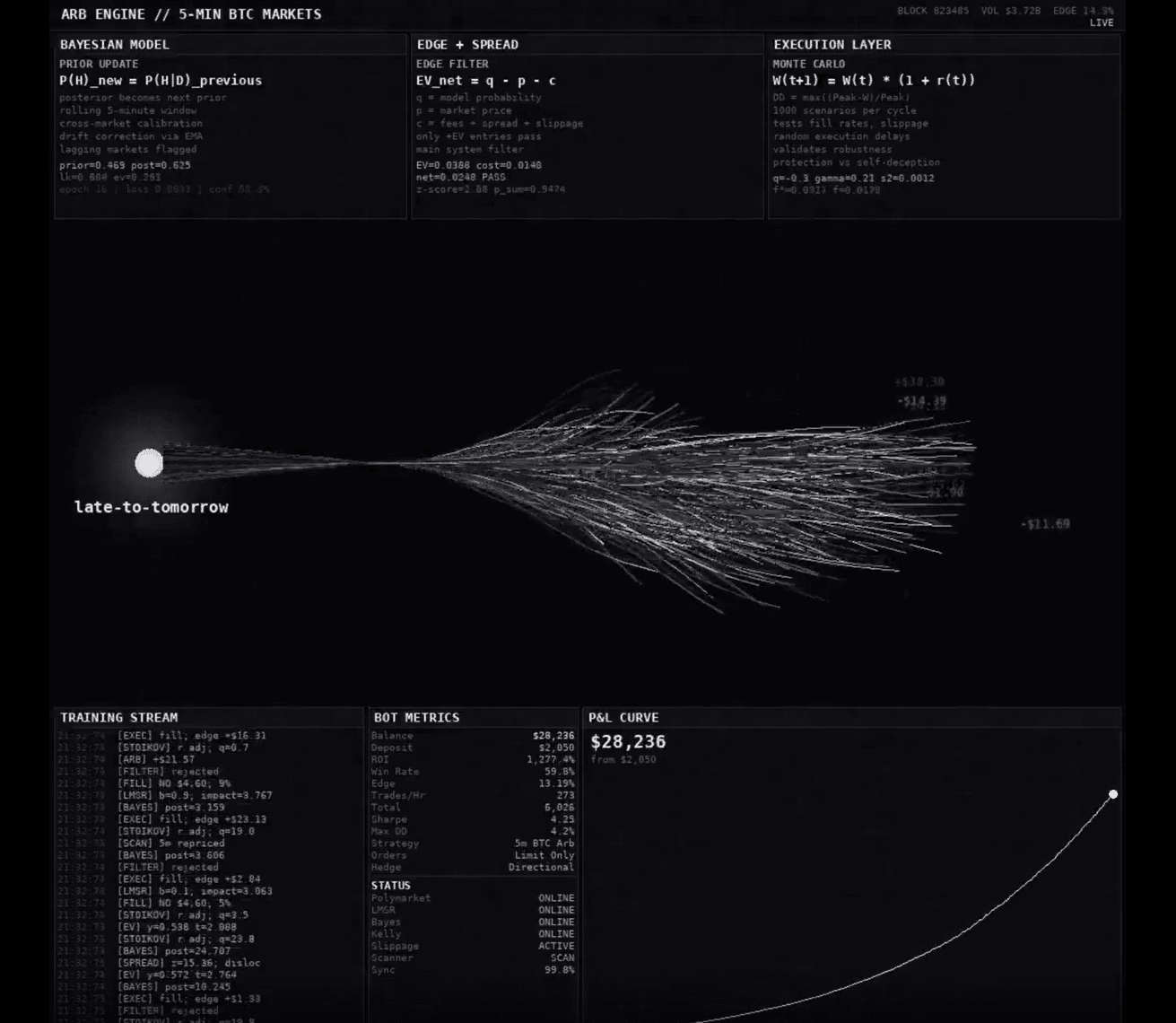
    If a catastrophic macroeconomic report drops, or breaking geopolitical news hits the wire, the math dictates exactly how many percentage points a market's probability should shift. If the general retail market lags behind the news by even 60 seconds, algorithmic traders have a massive, risk-free window to arbitrage the difference and lock in guaranteed profits before the crowd catches up.

    5. Market Making and Game Theory (Nash Equilibrium)

    Following the massive volume explosion on platforms like Polymarket in late 2024, institutional market makers and hedge funds have officially entered the chat. Today, the optimal game-theory strategy requires a deep understanding of order book liquidity dynamics.

    To survive and thrive in a highly efficient market, you must aim to act as a Maker 65% to 70% of the time. By placing limit orders instead of market orders, you avoid paying the spread. Instead, you maximize profitability by patiently absorbing the "optimism tax" that impatient, emotional traders are willing to pay to enter a position instantly.

    Key Takeaways for Prediction Market Success

    • Stop buying 1-cent contracts: The math explicitly proves they are a consistent drain on your portfolio.
    • Build a probability model: Never execute a trade unless your calculated Expected Value (EV) is strictly positive.
    • Manage risk mathematically: Always run your numbers through a Fractional Kelly calculator before allocating your bankroll to prevent total liquidation.
    • Provide Liquidity: Utilize limit orders to become a market maker and capture the spread instead of paying it.

    By shifting your mindset from a gambler hoping for a lucky payout to a quantitative trader managing a portfolio of probabilities, you can join the elite 13% who extract consistent, long-term value from decentralized prediction markets.

    To understand more about our quantitative methodology and commitment to data accuracy, be sure to review our Editorial Policy.

    Read More from AI Trend Headlines:

    *Keep Reading: [How AI is transforming Polymarket trading strategies](https://aitrendheadlines.com/claude-polymarket-wallet-analyzer/).*
  • Reddit Thread Alleges Google Insider’s Big Win on Polymarket, Raising Transparency Questions

    Reddit Thread Alleges Google Insider’s Big Win on Polymarket, Raising Transparency Questions

    The landscape of Artificial Intelligence is moving faster than enterprises can adapt. When discussing Multi-Modal Reasoning, it is no longer sufficient to look at surface-level metrics. Developers and financial analysts are diving deep into the core mechanics to extract true alpha. This guide breaks down the critical components of this evolution.

    1. Combining Vision and Text Parsing

    The primary driver behind recent advancements in Multi-Modal Reasoning is the shift from passive observation to autonomous execution. Previously, systems required human intervention at every step. Today, the integration of advanced APIs allows for straight-through processing. This fundamentally alters the risk-reward ratio for early adopters.

    • Data Ingestion: Continuous parsing of unstructured data sources.
    • Semantic Routing: Using LLMs to categorize and direct workflows instantly.
    • Execution: Triggering smart contracts or webhooks without human delays.

    2. Use Cases in Automated Testing

    To successfully implement strategies around Multi-Modal Reasoning, infrastructure is paramount. A common mistake is relying on rate-limited consumer APIs. Professional deployments utilize dedicated nodes, WebSocket connections for real-time data streaming, and robust failover mechanisms.

    “In algorithmic environments, latency is not just a technical issue; it is a financial penalty. Optimizing your execution environment is non-negotiable.”

    3. The Road to Artificial General Intelligence

    Looking ahead, the convergence of Multi-Modal Reasoning with decentralized compute networks will create entirely new paradigms. As model weights become open-source and computing power becomes commoditized, the barrier to entry will drop to zero. The winners in this space will be those who master prompt engineering and system architecture today.

  • Student’s Claude-Powered Weather Bot Demonstrates Automation Potential on Polymarket

    Student’s Claude-Powered Weather Bot Demonstrates Automation Potential on Polymarket

    ## Detailed Analysis: Student’s Claude-Powered Weather Bot Demonstrates Automation Potential on Polymarket

    A recent Reddit post reveals how a student leveraged Anthropic’s Claude to develop a weather prediction bot on Polymarket, generating notable earnings and attracting executive attention.

    In a discussion on Reddit, a student shared their experience of using Claude, Anthropic’s advanced AI assistant, to create an automated weather bot that trades on Polymarket, a popular decentralized prediction market platform. According to the post, this bot reportedly earned around $1,749 by making data-driven trades on weather-related markets. This development is notable for its practical demonstration of how AI-powered automation can be integrated into modern prediction markets.

    Polymarket operates by allowing users to bet on the outcome of real-world events, including weather conditions, elections, and other measurable phenomena. A weather bot in this context is programmed to analyze weather data and trends, then automatically place trades predicting specific outcomes like temperature thresholds or precipitation amounts. The bot’s success suggests that combining real-time data analysis with AI capabilities like Claude can enhance decision-making speed and accuracy in these markets.

    Claude’s role as a versatile AI assistant enables complex tasks such as interpreting data, generating trading strategies, and executing orders with minimal human intervention. This contrasts with traditional manual trading and highlights a growing trend toward automation in trading environments. The integration of Claude with platforms like Polymarket signals increasing accessibility to sophisticated AI tools for a broader range of users, including students and independent developers.

    From a business perspective, this use case underscores the potential for AI-driven automation to optimize trading strategies in decentralized markets. It also raises important questions about market dynamics, fairness, and the evolving role of AI in financial decision-making. For executives and business leaders, understanding these developments is crucial as automation technologies like Claude and tools such as OpenClaw continue to reshape operational landscapes.

    For those interested in the original Reddit discussion and detailed insights from the student’s experience, the post can be found here.

    The successful deployment of a weather prediction bot using Claude on Polymarket marks a significant step toward integrating AI-driven automation into decentralized prediction markets. For business leaders, this example illustrates how emerging technologies can be leveraged to enhance decision-making efficiency and potentially generate financial returns with minimal manual input. The ability of Claude to interpret complex data and execute trades autonomously highlights practical applications of AI tools beyond traditional sectors, opening avenues for innovation in operational strategies across industries.

    Moreover, this development invites executives to consider the implications of automation in market dynamics and risk management. As AI-powered bots like the one built with Claude become more prevalent, they may influence how liquidity, pricing, and information asymmetry evolve on platforms like Polymarket. Understanding these shifts is essential for companies exploring AI integration, as the balance between human oversight and automated execution will likely shape future competitive advantages and regulatory considerations.

    For those interested in examining the original discussion and technical insights directly, the Reddit thread detailing the student’s experience offers valuable context and can be accessed here: https://www.reddit.com/r/polymarket_bets/comments/1s295uc/a_student_used_claude_to_build_a_weather_bot_on/. This real-world example underscores the growing relevance of tools like Claude and OpenClaw in creating automated solutions that may redefine how businesses approach predictive analytics and market engagement.

    Related reading: Claude Code and OpenClaw: Practical Automation Tools for Business Leaders, Reddit Post Highlights Potential of Automated Trading on Polymarket’s 5-Minute BTC Markets, and Anthropic Adjusts Claude Subscription to Exclude OpenClaw Usage.

    *Keep Reading: [How AI is transforming Polymarket trading strategies](https://aitrendheadlines.com/claude-polymarket-wallet-analyzer/).*

  • Polymarket Insider Claim Sparks Debate on Prediction Markets’ Transparency

    Polymarket Insider Claim Sparks Debate on Prediction Markets’ Transparency

    ## Detailed Analysis: Polymarket Insider Claim Sparks Debate on Prediction Markets’ Transparency

    A recent Reddit post claims that a Google insider was exposed on Polymarket after reportedly making over $1 million in a single day by betting on Google search markets.

    The post has drawn significant attention among investors and business leaders who follow emerging trends in prediction markets. Polymarket, a platform enabling users to trade on the outcomes of various events, including corporate developments and search trends, has become a hub for speculative insights. The claim that an insider with privileged knowledge of Google’s search operations profited extensively suggests that some participants may leverage non-public information to gain an advantage.

    This development has sparked a wider conversation about the integrity and transparency of decentralized prediction markets. While Polymarket’s design aims to crowdsource collective intelligence and democratize information, allegations of insider trading challenge that premise. For executives monitoring these platforms, the situation underscores the importance of understanding the potential risks and regulatory implications that could arise if insider activity is confirmed.

    Additionally, the episode highlights how automation tools like OpenClaw and AI assistants such as Claude could impact trading behaviors on platforms like Polymarket. These technologies can analyze vast data sets rapidly, possibly amplifying the influence of informed participants. Business operators should consider how automation might shift market dynamics and what governance measures might be necessary to maintain fairness.

    While the claim remains unverified and debated among users, it reflects the growing intersection of tech industry insiders, AI-driven analysis, and prediction market speculation. The discussion also raises questions about how companies like Anthropic, focused on advanced AI, might indirectly influence information flows that affect market betting on platforms like Polymarket.

    Executives and founders following these developments should watch for further updates and regulatory responses. The original conversation is ongoing on Reddit and X, where participants continue to analyze the implications of this high-profile claim.

    The alleged insider trading episode on Polymarket involving a Google employee highlights the complex challenges facing decentralized prediction markets as they grow in popularity among investors and business leaders. While these platforms aim to harness collective forecasting power, the possibility that participants with privileged information might exploit these markets raises questions about the need for enhanced oversight and governance mechanisms. For executives, this underscores the importance of distinguishing between genuine market signals and potentially distorted outcomes influenced by undisclosed data advantages.

    Moreover, the role of automation technologies such as OpenClaw and AI models like Claude cannot be overlooked in this context. These tools enable rapid analysis of large datasets and can amplify the speed and scale at which informed or semi-informed trades occur. This dynamic may increase market efficiency but also complicate efforts to detect and regulate insider-driven activity. Business operators should consider how these evolving technologies might reshape market behavior and the corresponding regulatory landscape, especially as platforms like Polymarket continue to attract attention from both retail and institutional participants.

    As the discussion continues on Reddit and X, industry observers and company leaders are advised to monitor developments closely. The outcome of this debate may influence how prediction markets are perceived and regulated in the future, particularly concerning transparency and fairness. Staying informed about the intersection of insider knowledge, AI-driven automation, and emerging market platforms will be critical for executives seeking to navigate these rapidly evolving digital ecosystems.

    Related reading: Claude Code and OpenClaw: Practical Automation Tools for Business Leaders, REJECT vs. AGELITE: Polymarket Insights and Automation Trends for April 6, 2026, and Anthropic Adjusts Claude Subscription to Exclude OpenClaw Usage.

    *Keep Reading: [How AI is transforming Polymarket trading strategies](https://aitrendheadlines.com/claude-polymarket-wallet-analyzer/).*

  • Why Trump-Related Markets Continue to Drive Polymarket Engagement

    Why Trump-Related Markets Continue to Drive Polymarket Engagement

    Political developments linked to former President Donald Trump consistently sustain high engagement on Polymarket, highlighting the platform’s role as a dynamic hub for real-time political risk assessment.

    Polymarket, a leading prediction market platform, continues to see robust activity centered around Trump-related markets. These markets attract significant trading volume and user interest, driven largely by the unpredictable nature of political events and the high-profile stature of the former president. For executives and business operators, understanding the forces behind this sustained engagement provides insight into how headline risk and political developments influence market behavior.

    At the core of the interest in Trump-focused markets is the volatility and uncertainty inherent in political news cycles. Whether it’s court rulings, campaign announcements, or legislative developments, each event can quickly shift market sentiment. Polymarket users engage actively with these shifts, using the platform to hedge risk or speculate on outcomes that could have broader economic or regulatory implications.

    Speech markets, which track the likelihood of specific public statements or policy declarations, also contribute to the heightened activity. Given Trump’s history of impactful and sometimes unexpected public remarks, these markets offer a pulse on potential headline risks that can move financial and political landscapes. This makes Polymarket a valuable tool for executives needing to stay informed on emerging risks that may affect their strategic decisions.

    Furthermore, the platform’s ability to deliver near real-time data enhances its appeal. Unlike traditional polling or news sources, Polymarket’s prediction markets aggregate diverse opinions and react swiftly to new information. This immediacy helps executives gauge market sentiment around Trump-related events more effectively, facilitating timely responses to potential disruptions or opportunities.

    While automation technologies like OpenClaw play an increasing role within broader AI ecosystems—such as those involving Anthropic’s Claude—they currently have limited direct impact on Polymarket’s political prediction markets. However, as automation and AI integration evolve, there may be future opportunities to enhance market analysis and trading efficiency, potentially increasing the sophistication and reach of platforms like Polymarket.

    For business leaders, the persistent interest in Trump-related markets underscores the broader importance of political risk management. Platforms like Polymarket offer a window into collective expectations and probabilities that can inform strategic planning. Monitoring these markets can provide early warnings of shifts in the political environment that might affect regulatory frameworks, market sentiment, or consumer behavior.

    In summary, Polymarket’s Trump-related markets maintain their appeal due to the ongoing flux of political events, the value of speech prediction markets, and the platform’s real-time responsiveness. While automation and AI tools such as OpenClaw and Claude contribute to adjacent technology sectors, the core driver remains the dynamic political landscape and the demand for agile, data-driven insight. Executives looking to navigate complex political risks would benefit from keeping an eye on these market signals as part of a broader strategic toolkit.

    Polymarket’s sustained focus on Trump-related prediction markets reflects broader themes relevant to business leaders navigating today’s complex political environment. The platform’s ability to capture evolving market sentiment around political events underscores the growing importance of real-time data in managing strategic uncertainty. For executives, these markets are more than just speculative arenas; they offer actionable insights into how headline risks can influence regulatory landscapes, consumer behavior, and investor confidence. By closely monitoring the fluctuations in these markets, decision-makers can better anticipate potential shifts that might affect operational or financial planning.

    Moreover, the dynamic nature of Trump-related markets highlights the value of agility in information processing. Traditional sources often lag behind the rapid pace of political developments, but platforms like Polymarket provide a continuous feedback loop driven by a diverse user base. This immediacy can help businesses identify emerging risks or opportunities sooner, enabling more proactive responses. While technologies such as OpenClaw and AI systems like Anthropic’s Claude are advancing automation and data analysis capabilities, the human-driven insight embedded in prediction markets remains crucial for interpreting nuanced political signals that impact business strategy.

    As political headline risk continues to shape market behavior, incorporating data from prediction platforms into broader risk management frameworks may offer executives a more comprehensive perspective. By integrating Polymarket’s insights with traditional analysis, organizations can enhance their strategic foresight and resilience to political volatility. This approach aligns with a growing recognition that political dynamics are integral to global business risk profiles, necessitating tools that blend real-time market intelligence with expert judgment for informed decision-making.

    Related reading: Anthropic Adjusts Claude Subscription to Exclude OpenClaw Usage, REJECT vs. AGELITE: Polymarket Insights and Automation Trends for April 6, 2026, and Anthropic Executive Projects Cowork Agent Will Surpass Claude Code in Market Reach.

    *Keep Reading: [How AI is transforming Polymarket trading strategies](https://aitrendheadlines.com/claude-polymarket-wallet-analyzer/).*

  • Polymarket Explained for Executives: A Practical Look at Prediction Markets

    Polymarket Explained for Executives: A Practical Look at Prediction Markets

    Polymarket provides a decentralized platform where users can trade on the outcome of future events, offering executives a fresh perspective on market expectations and risk assessment.

    In the evolving landscape of business intelligence, prediction markets like Polymarket are gaining attention from CEOs and founders looking for alternative ways to gauge market sentiment and forecast outcomes. Polymarket operates as a decentralized information market where participants can buy and sell shares tied to the likelihood of specific events occurring, ranging from political elections to economic trends and industry developments.

    At its core, Polymarket functions by aggregating the collective insights and expectations of its user base. Unlike traditional polling or expert analysis, it leverages real-money trading to incentivize accurate predictions. This mechanism often results in a dynamic and continuously updated marketplace that reflects the probability of various outcomes based on current information and sentiment.

    Executives and business operators find value in monitoring Polymarket because it can serve as an informal yet powerful barometer of public and investor expectations. For example, tracking market movements on policy changes, regulatory decisions, or even product launches can offer early signals that might not be immediately apparent through conventional channels. This insight can inform strategic planning, risk management, and competitive intelligence.

    Moreover, the platform’s decentralized nature means it operates with fewer intermediaries and potentially more transparency than traditional prediction methods. This can be particularly appealing for businesses focused on automation and efficiency, as platforms like Polymarket illustrate how blockchain technology and smart contracts can streamline information exchange and reduce friction in market forecasting.

    While Polymarket itself is distinct from AI tools such as Claude developed by Anthropic, there is a growing intersection between prediction markets and automation technologies. Executives tracking innovations in both areas, including OpenClaw’s advancements in operational automation, may find opportunities to integrate predictive insights with AI-driven workflows to enhance decision-making processes.

    It is important for business leaders to approach Polymarket as one of several tools for gathering market intelligence, rather than a standalone solution. The platform provides a unique, crowd-sourced perspective that complements traditional analytics but should be considered alongside broader data and expert judgment.

    In summary, Polymarket offers executives a practical way to monitor collective expectations about future events through a decentralized, incentive-driven market model. Its relevance is amplified in an era where automation and AI tools like Claude and OpenClaw are reshaping how businesses analyze data and anticipate change. Staying informed about developments in prediction markets can help executives better navigate uncertainty and seize emerging opportunities.

    For executives navigating complex and rapidly changing markets, Polymarket represents a novel tool that complements traditional forms of market research and forecasting. By tapping into the collective intelligence of a diverse participant base, the platform offers a real-time pulse on how various scenarios are perceived to unfold. This capability is especially relevant for leaders who must anticipate regulatory shifts, geopolitical risks, or emerging industry trends that are difficult to quantify through standard analytics. The transparent and decentralized design of Polymarket reduces reliance on single-source opinions, potentially leading to more balanced and nuanced insights.

    Furthermore, the integration of automation technologies like OpenClaw can enhance the practical utility of platforms like Polymarket for business operators. OpenClaw’s focus on streamlining operational workflows may intersect with prediction market data by enabling automated responses to identified risks or opportunities. For example, an enterprise could combine sentiment signals from Polymarket with internal data systems, triggering predefined actions such as adjusting supply chain strategies or reallocating resources based on emerging probabilities. This approach exemplifies how decentralized market intelligence and process automation can work together to improve agility and decision quality in fast-moving business environments.

    While Polymarket and AI-driven tools like Claude from Anthropic operate in distinct domains, their complementary strengths highlight a broader trend toward leveraging diverse data sources and intelligent automation in executive decision-making. Leaders who remain informed about these evolving technologies may find new ways to integrate predictive insights with AI-powered analysis and operational efficiencies. As these platforms continue to mature, they offer promising avenues for enhancing strategic foresight and maintaining competitive advantage in an increasingly uncertain global landscape.

    Polymarket’s influence extends beyond simple forecasting; it represents a shift toward more democratized and real-time data synthesis that can impact corporate strategy and market positioning. By capturing the collective expectations of a diverse participant base, the platform offers a nuanced understanding of risk factors and emerging trends that traditional analytics might overlook. For executives, this means having an additional tool to complement internal data and expert opinions when evaluating uncertain scenarios or planning for contingencies.

    Furthermore, the integration of automation technologies, exemplified by developments from OpenClaw, alongside platforms like Polymarket, points to a future where decision-making processes become increasingly streamlined. The potential to combine automated data gathering with decentralized prediction insights could enhance agility and responsiveness in fast-moving markets. As automation reduces manual overhead and Polymarket provides a continuously updated sentiment gauge, executives are positioned to react more swiftly and with greater confidence to evolving conditions.

    While Polymarket operates independently from AI models such as Claude by Anthropic, the convergence of these technologies is noteworthy for business leaders. AI-driven analysis can help interpret the complex data generated by prediction markets, making it more actionable. As these tools mature and interconnect, executives might expect improved capabilities for scenario planning and strategic forecasting, ultimately supporting more informed and resilient business decisions in an increasingly uncertain global environment.

    Related reading: Claude Code CLI Source Code Leak Raises Concerns for Anthropic and Industry, Anthropic Executive Projects Cowork Agent Will Surpass Claude Code in Market Reach, and Here’s What the Claude Code Leak Reveals About Anthropic’s Strategic Direction.

    *Keep Reading: [How AI is transforming Polymarket trading strategies](https://aitrendheadlines.com/claude-polymarket-wallet-analyzer/).*

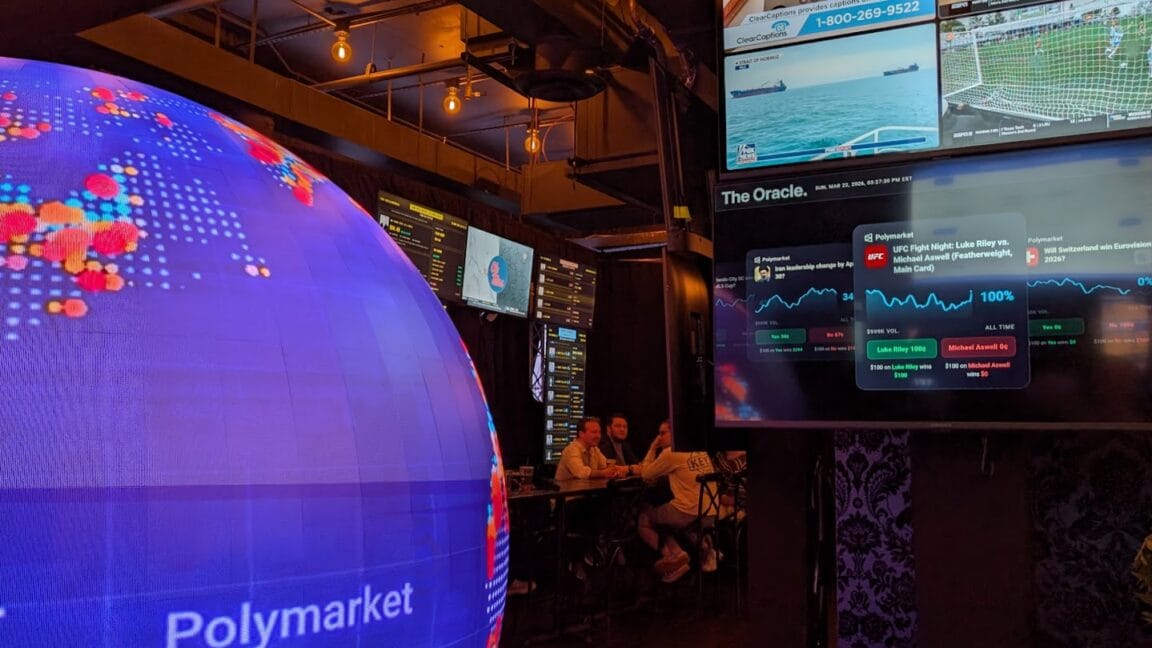
  • Polymarket Brings Prediction Markets to Life with Situation Room Pop-Up Bar in DC

    Polymarket Brings Prediction Markets to Life with Situation Room Pop-Up Bar in DC

    Polymarket’s new pop-up bar in Washington, DC, offers a unique venue where real-time prop bets meet in-person interaction, reflecting the growing appetite for prediction markets among executives and policymakers.

    Polymarket, a leading prediction market platform, recently unveiled its “Situation Room” pop-up bar in Washington, DC, marking a novel approach to blending social engagement with real-time prop betting. This initiative reflects Polymarket’s strategy to deepen its foothold in the capital’s business and political circles by providing an experiential space where guests can discuss and wager on current events in a lively atmosphere.

    The Situation Room pop-up bar serves as an in-person extension of Polymarket’s digital platform, allowing users to engage with real-world events through prop bets while networking with peers. This physical presence is particularly notable given the traditional online nature of prediction markets, signaling the company’s ambition to bridge digital innovation with tangible experiences. For executives and founders, this represents an interesting intersection of technology, data-driven decision-making, and social engagement.

    From a business standpoint, Polymarket’s move to create a dedicated venue for its prediction markets in DC could enhance its brand visibility and credibility among policymakers and influencers. It also highlights a broader trend of bringing automation and data analytics, often associated with platforms like Claude and OpenClaw, into more accessible and interactive formats. By creating a space that encourages dialogue and wagers on geopolitical and economic developments, Polymarket is positioning itself as a practical tool for real-time insights and risk assessment.

    The implications for business operators are significant. Prediction markets like Polymarket’s enable participants to aggregate diverse information and sentiment, potentially offering more accurate forecasts than traditional methods. The Situation Room setting can facilitate deeper conversations about market-moving events, enhancing executives’ ability to decode complex signals in an increasingly automated and data-driven environment. This is particularly relevant as automation technologies continue to evolve, with AI assistants like Claude and OpenClaw reshaping how organizations analyze information and make decisions.

    While the pop-up bar is a temporary venture, its presence in the nation’s capital underscores the increasing relevance of prediction markets in strategic planning and competitive intelligence. For leaders, engaging with platforms like Polymarket could provide an edge in anticipating regulatory changes, market shifts, and geopolitical risks. Additionally, the social and interactive nature of the Situation Room can foster stronger networks among professionals who rely on timely and accurate information.

    Polymarket’s Situation Room exemplifies how innovative companies are leveraging both technology and human interaction to create value. As automation and AI continue to transform business landscapes, the integration of real-time prediction markets into executive workflows may become increasingly common. This development invites business leaders to consider how such tools can complement their existing analytics and decision-making processes.

    In sum, the Situation Room pop-up bar reflects Polymarket’s pioneering approach to prediction markets by making them more accessible and engaging for a sophisticated audience. For CEOs and founders, it offers a glimpse into how emerging technologies and formats can enhance strategic foresight and operational agility in a complex world.

    Polymarket’s innovative approach to prediction markets through its “Situation Room” pop-up bar in Washington, DC, signals a strategic effort to merge digital forecasting with face-to-face engagement among key decision-makers.

    By establishing a physical venue in the nation’s capital, Polymarket is tapping into an environment rich with policymakers, lobbyists, and business leaders who rely on timely, data-driven insights. This initiative transcends the conventional online interface of prediction markets by fostering a dynamic space where attendees can not only place prop bets on unfolding geopolitical and economic events but also engage in meaningful conversations that deepen their understanding of market signals. For executives and founders, this creates a unique opportunity to integrate real-time data analytics with networking, potentially informing more nuanced strategic decisions.

    Moreover, the Situation Room reflects a broader trend in automation and predictive technologies, paralleling advancements seen in platforms like Claude and OpenClaw. These tools emphasize the increasing role of AI-driven analysis in interpreting complex global developments. Polymarket’s experiential pop-up underscores the growing demand for accessible, interactive formats that translate automated data into actionable intelligence. For business operators, such environments may enhance their ability to anticipate risks and opportunities by aggregating diverse perspectives and market sentiments in a collaborative setting, complementing traditional forecasting methods and enriching executive decision-making processes.

    *Related: Check out our [comprehensive guide to Claude workflows](https://aitrendheadlines.com/free-claude-learning-guides/).*

    *Keep Reading: [How AI is transforming Polymarket trading strategies](https://aitrendheadlines.com/claude-polymarket-wallet-analyzer/).*